Repetitive retrading is an example of a knotty Reformed National Pricing market issue that needs to be fixed. Here we examine how policymakers are working with industry to address the issue – and ask whether this could serve as a blueprint for a more rapid, collaborative approach to market reform.
Repetitive retrading has been lurking in the undergrowth of the balancing mechanism, probably understood only by its practitioners and the NESO control room
See it, say it, sorted! Delivering rapid incremental reform
In 2024 Regen put forward an agenda for 'progressive market reform'. We argued that a package of incremental reforms would be more pragmatic and manageable than radical market redesign, while still delivering the far-reaching changes required. The government has broadly adopted this approach with the Reformed National Pricing (RNP) delivery plan.
We also recognised, however, that the risk of an incremental programme is loss of focus, the dispersal of resources and a quagmire of consultations. Strong executive leadership and management will be needed, with DESNZ, Ofgem and NESO working together coherently, in close collaboration with industry.
The challenge of repetitive retrading is a current example of the kind of challenge where a rapid collaborative approach could serve as a blueprint for a 'see it, say it, sorted' approach.
Repetitive retrading: a case study in market reform
As with many of the market issues raised as part of the Review of Electricity Market Arrangements, repetitive retrading is not a new problem. It has been there, lurking in the undergrowth of the balancing mechanism, probably understood only by its practitioners and the NESO control room.
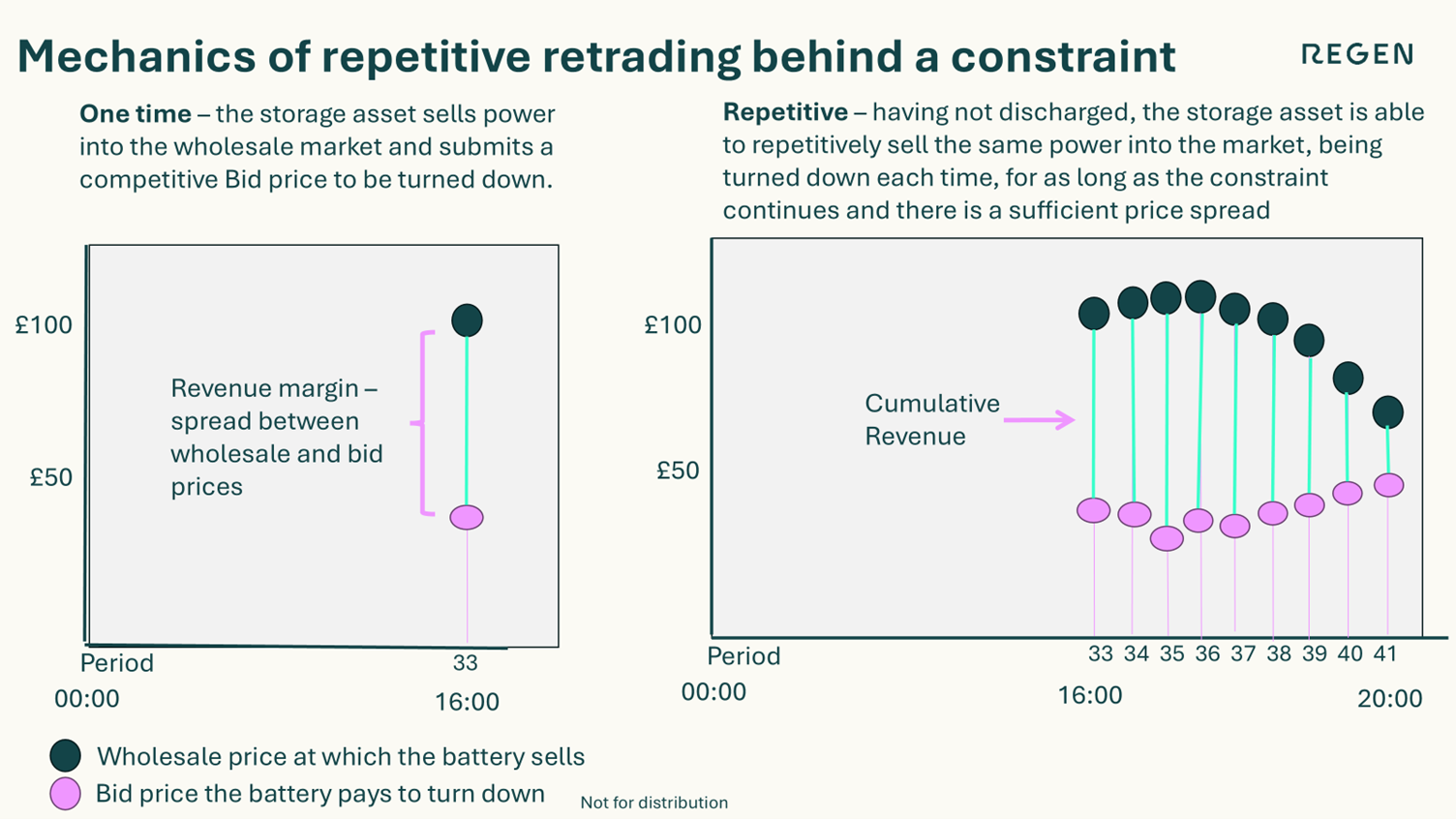
Repetitive retrading occurs when a storage asset, usually pumped hydro but now also some battery storage assets, notifies its intention to discharge behind a constraint. The discharge could be because they have sold power to capture a high wholesale price, or because they wish to reposition the storage asset’s state of charge (its available capacity) to meet the conditions of a system service such as Quick Reserve. Its discharge notification will be accompanied by a bid price that would allow the control room to redispatch the asset and turn down its discharge to help manage a constraint, or for other balancing purposes. All of that is entirely legitimate and typical behaviour for a dynamic storage asset that is optimising its revenue streams.
The issue of repetitive retrading arises when the storage asset’s bid price is accepted and it is then turned down. It will now make a legitimate profit, which is the difference between its bid price and the wholesale market price at which it sold its power. Under Transmission Constraint Licence Condition (TCLC) rules, this profit should not be 'excessive' – roughly what it would have made in the absence of the constraint, plus any additional costs associated with being turned down.
But the storage asset will have retained its charge and can now trade the same power in a subsequent time period. If the constraint persists, it could have its bid price accepted again and then be turned down, making an additional profit and once again retaining its charge, which could be resold a third, fourth and fifth time and so on.
Each retrade cycle provides additional profit for the asset, but also increases the volume of constraints and the cost of turning up another generator on the other side of the constraint boundary to meet demand. Each retrade could be seen as a legitimate transaction with a non-excessive benefit, but the cumulative impact of repetitive retrades adds to the overall cost of constraint management, which is passed to the consumer. More importantly, perhaps, the storage asset, which is intended to provide system value and services, is being mis-dispatched – adding to system costs rather than alleviating them.
See it! Recognising and understanding the need for reform
The start of the reform process is to recognise that there's a problem and to properly analyse both its cause and consequences.
The problem of repetitive retrading is contentious. On the one hand, any behaviour which increases consumer costs via an increase in balancing costs must be addressed, but on the other, it could be argued that storage operators are trading in a legitimate way as any other generator would do, and are already under TCLC regulation.
The trading and balancing behaviour of storage is governed by sophisticated optimisation tools that continually seek to position the asset to maximise income from multiple, sometimes competing, sources. There is also revenue at stake, which could impact the viability of storage assets. The stakes are, therefore, high, and it would be easy to jump to the wrong conclusion that storage assets are bad actors. Equally, the industry could fall back into a defensive line that the problem either doesn’t exist, is trivial or belongs to someone else.
The key enabler is to have clear evidence and analysis, building a case for change that everyone can agree on. The data published on repetitive retrading in NESO's RNP call for input outlines a consumer cost of £136 million. Industry has called for a breakdown between technologies and disputed the inclusion of wholesale costs. It has taken a few rounds of workshops and some contested data, but we seem to have arrived at a clearer understanding of the repetitive retrading issue and its scale through the NESO operational review of storage behind constraints. Regen and the Electricity Storage Network have helped bring our members together for this workstream with NESO.
While the analysis has focused on retrading behind a constraint, the discussion between NESO and industry has also identified similar behaviour that could occur in front of a constraint and in other instances. This has helped both the system operator and storage asset owners and optimisers better understand their mutual goals of reducing system costs and ensuring that storage assets remain viable by being properly rewarded for the services they provide.
Say it! Opening a dialogue to develop solutions
Having established that the issue is real and needs to be addressed, NESO has convened bilateral and workshop sessions to develop a long list of possible solutions.
The approach has been pragmatic, recognising the need for a rapid, short-term solution, even if imperfect, while a longer-term solution is developed. Rather than imposing a preconceived solution, there has been a willingness to work with industry to develop something that is both fit for purpose and can be implemented quickly. Even some of the more unlikely long-list solutions have served a purpose to better understand how the needs of the system and storage sector can be met.
Sorted? Not quite, but it is within sight
We can’t quite claim that the solution has been implemented; that test is still to come. It is positive, however, that the long-list has been reduced to three or four practical solutions that could be implemented within a short timeframe; months rather than years.
As expected, the short-term solution will likely come down to a monitoring methodology to identify when retrading occurs and to separate this activity from storage behaviour that is related to the provision of system services, and changes to balancing mechanism protocols that would either disincentivise retrading and/or allow the control room to either deliberately skip the storage asset in redispatch or to limit the number of retrades. The NESO and Ofgem market monitoring teams already work closely together on the issue of repetitive retrading.
The short-term solution could require Ofgem to clarify the TCLC regulations and how they govern storage retrade behaviour. This would then give more clarity to the industry and help inform operational decision making.
One complicating factor is that NESO is also under increasing pressure to reduce skip rates in the balancing mechanism (instances when a lower-cost asset is omitted from redispatch despite being in merit order). Deliberately skipping a storage asset to prevent repetitive retrading could be misreported as a skip and, therefore, a black mark against NESO. It should be possible, however, to identify deliberate skips.
It is positive that the repetitive retrading engagement between NESO and the industry is also considering the long-term role of storage and how it should best be used to provide valuable system services. It is significant that, alongside the issue of repetitive retrading, there is a very long list of positive reforms and enhancements enabling storage providers to earn a legitimate income from delivering valuable system services.
These include:
Continuing steps to increase the participation and utilisation of storage in the balancing mechanism, including the upgrade to the Open Balancing Platform for system actions
A wider review of the TCLC rules and how they should be applied to storage, recognising that storage assets are designed to provide flexibility and system services in a price-competitive market and should be able to exploit valid market signals
Introduction of new dynamic parameters and a Future State of Energy model via Grid Code 0166 provides the system operator with greater visibility and information and enables it to optimise storage actions over multiple time periods and in scheduling timescales. This intertemporal and visibility challenge has been identified in several reform proposals, including those set out by Regen, AFRY, and LCP Delta and Frontier. Embedding this new data in operational actions from the control room will improve outcomes for the sector and consumers.
A review of the state of charge requirements for system services, including dynamic response (Dx), balancing reserve and quick reserve, to encourage more efficient storage actions on both sides of a constraint
A wider review of retrading behaviour by generation assets, and by both generation and storage assets in front of constraint boundaries
The introduction of new boundary flow smoothing and intertrip services that would provide additional revenue opportunities for storage and valuable new system services to increase grid availability
Locational procurement of system services, including dynamic response services, quick reserve and balancing reserve
A proposal for NESO to replace quick reserve with a new service, named capacity reserve, allowing NESO to procure GWs and GWhs of BESS reserve across an entire day for NESO’s sole use in the balancing market.
A blueprint for faster, collaborative market reform
Repetitive retrading is an example of the complex issues that arise as we radically change our power system where reform could save consumers tens, if not hundreds, of millions of pounds per year. It also points to a broader need to ensure we maximise the value created by storage assets.
The key enabler to resolution is to have clear evidence and analysis, building a case for change that everyone can agree on. A collaborative process between NESO, Ofgem and industry can then build trust and a shared understanding as to the problem and ‘solution space’.
The reforms on the table look promising. Even better, the positive engagement with industry has led to a positive discussion about pragmatic steps to ensure that storage adds system value and reduces consumer costs. This is a much better framing for the collaboration between industry, the regulator and NESO.
There is still a way to go before we can say the challenge is 'sorted'. There is a risk that the consensus and collaboration could fragment as we move to decisions. However, the work so far points to a blueprint for delivering a ‘radical incrementalism’ programme of market reform.



%20(1).jpg)