Our latest paper provides a summary of the forecasts for biomethane production and assesses the likely availability of sustainable biogas feedstocks, as well as current and future policies to support biomethane production and demand decarbonisation.
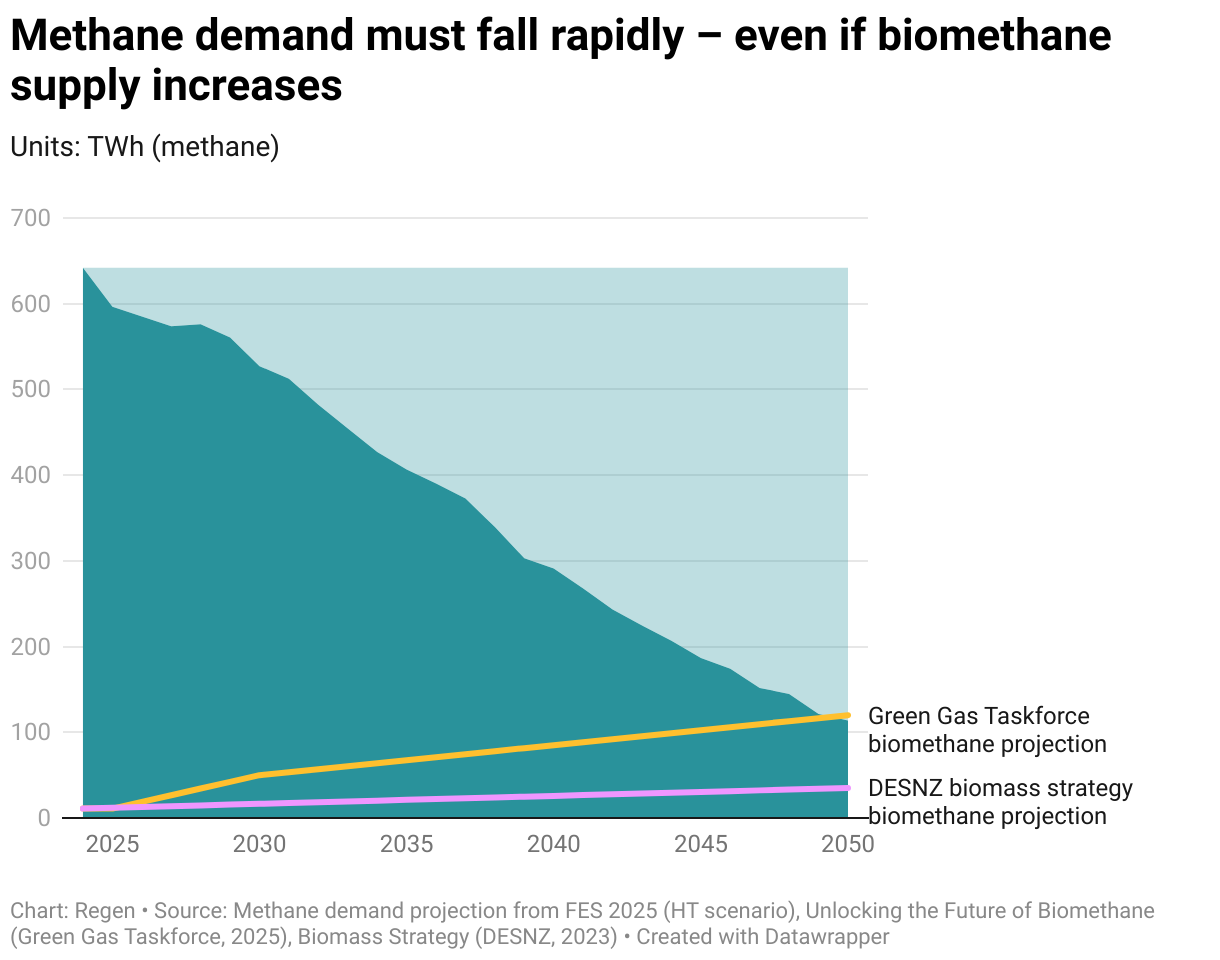
It finds that biomethane could make a significant contribution to future gas demand – but only if the UK can significantly reduce demand for fossil methane in heating, industry and power generation in the coming decades.
Future biomethane supply will be the limiting factor
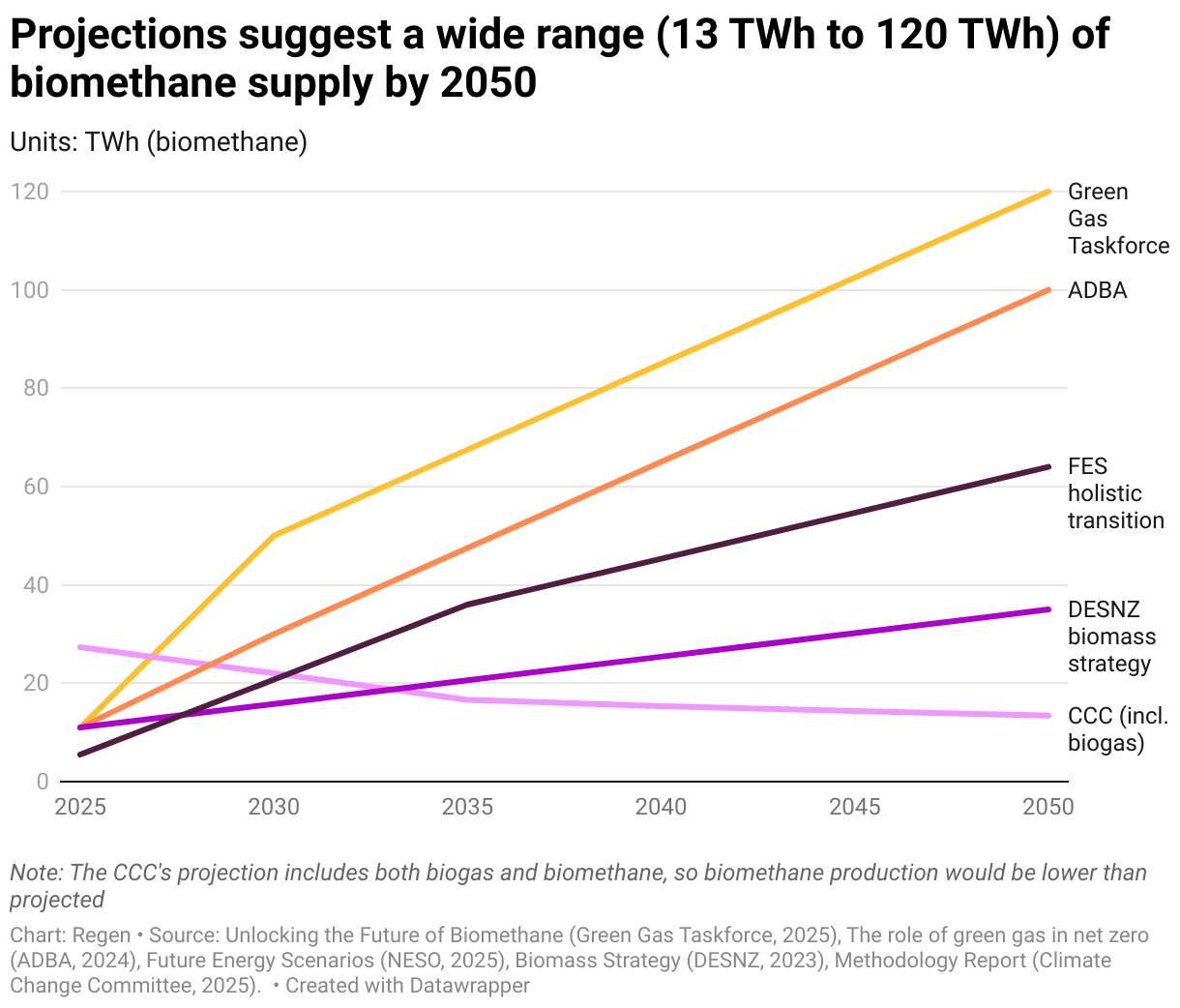
As a direct replacement for fossil methane, biomethane is an attractive and versatile fuel that could be used for a wide range of energy applications. Our report, however, highlights that, across all credible scenarios, the availability of sustainably produced biogas feedstock, plus the cost of refinement to a biomethane-grade fuel, will be the limiting factors. A literature review of future forecasts suggests that between 13 and 120 TWh of biomethane could be produced in GB by 2050 – a fraction of the current demand for fossil gas of almost 700 TWh.
The sustainability of biomethane feedstocks and production is critical
The Green Gas Support Scheme requires biomethane to have a production carbon intensity lower than 86.4 kgCO2e/MWh. Studies by the European Biogas Association and the European Commission Joint Research Centre have shown that some biomethane feedstocks do not always meet this standard and can have higher whole-cycle emissions than fossil methane.
Across all forecasts, the extent of the use of energy crops is a key factor. In credible scenarios, some use of energy crops is anticipated, but with growing concern around embedded emissions and competition for land use, the development of large-scale energy crops is considered both unlikely and undesirable.
Biomethane must be targeted at those energy demands where it can add the most value
Given a limited supply, it makes sense for policies to encourage the use of biomethane in those areas where it can add the most value, both in terms of decarbonisation and its contribution to the economy and energy system. Using high-level criteria, Regen’s analysis points to a potential high-value use as an energy store to provide peaking/back-up power generation, targeted use in some non-road transport and industrial applications and, potentially, as a local energy supply for agricultural and rural energy demand.
The use of biomethane for power generation will depend on the relative cost and scale of biomethane production vis-à-vis alternatives such as CCUS, hydrogen for power, electricity storage and interconnectors. The greater focus on biomethane for power suggested in this report tallies with the interest in biomethane expressed by the Committee on Climate Change and in the development of NESO’s Strategic Spatial Energy Plan.
Importantly, Regen’s analysis concludes that while some grid injection of biomethane may be a pragmatic way to reduce the carbon emissions for industrial gas users, biomethane should not be considered a direct replacement for fossil methane for domestic and commercial heat, and should not therefore slow down the drive for heat electrification.