Plug-in batteries could significantly reduce household electricity bills, particularly for renters, flat dwellers and low-income households, who are largely excluded from installing traditional home battery systems today. The government has already announced regulation changes to make plug-in solar panels available as part of its response to the rise in energy costs caused by the US war with Iran. In this blog, Regen argues they should go one step further and make standalone plug-in batteries available too.
The Windfall Battery is a plug-in option designed for flats and renters by London-based start-up Windfall Energy Ltd
Plug-in batteries: putting power in people’s hands
Rooftop solar and home battery systems are a well-established pillar of the government’s net zero and energy security strategy. But to date, systems that can be plugged into a regular wall socket have not been legal in Great Britain. This is in stark contrast to mainland Europe, where plug-in systems are commonplace and can be bought off the shelf from Ikea or Lidl.
Plug-in solar has been available for almost a decade in Germany, where there are now more than a million systems in place. In March this year, the UK government announced regulation changes to make plug-in solar panels available ‘within months’, as part of its response to the rise in energy costs caused by the US war in Iran. However, the announcement was noticeably quiet on plug-in batteries.
In this insight piece, we discuss:
What a plug-in battery is and how they work
How much households could save
Who would benefit (spoiler, it’s those currently cut out from the benefits of home batteries)
The wider energy system benefits
The next steps for government on safety and regulation.
What is a plug-in battery and how does it work?
A plug-in battery is a portable energy storage unit that can be plugged into a standard wall socket without any modification to the household wiring. It charges by drawing electricity through the socket – typically during the off-peak period of a time-of-use tariff – and discharges back through the same socket to offset household demand at times when electricity is more expensive.
Unlike traditional domestic battery systems, which must be hardwired into the home’s electrical system by a qualified electrician, plug-in batteries can be bought off the shelf and plugged into a wall socket like any other household appliance.
Illustrative schematic of how a plug-in battery can integrate with an existing home circuit and consumer unit to power household appliances.
This removes the need for professional installation and significantly reduces the cost compared to a traditional system. Typically around £1,000 to 1,500 of the total cost of a professionally installed home battery is for installation. This cost component doesn’t scale directly with storage capacity, so small systems have a very high cost per kWh. Conversely, unit costs of plug-in systems are very low.
Chart comparing cost per kWh of different scales of battery storage. Regen analysis of UK installation and project costs.
How much could households save with a plug-in battery?
A battery paired with a time-of-use tariff lets households charge when electricity is cheap and discharge when it is expensive. The household saves money overall when the bill reduction over the battery’s lifetime exceeds its upfront cost.
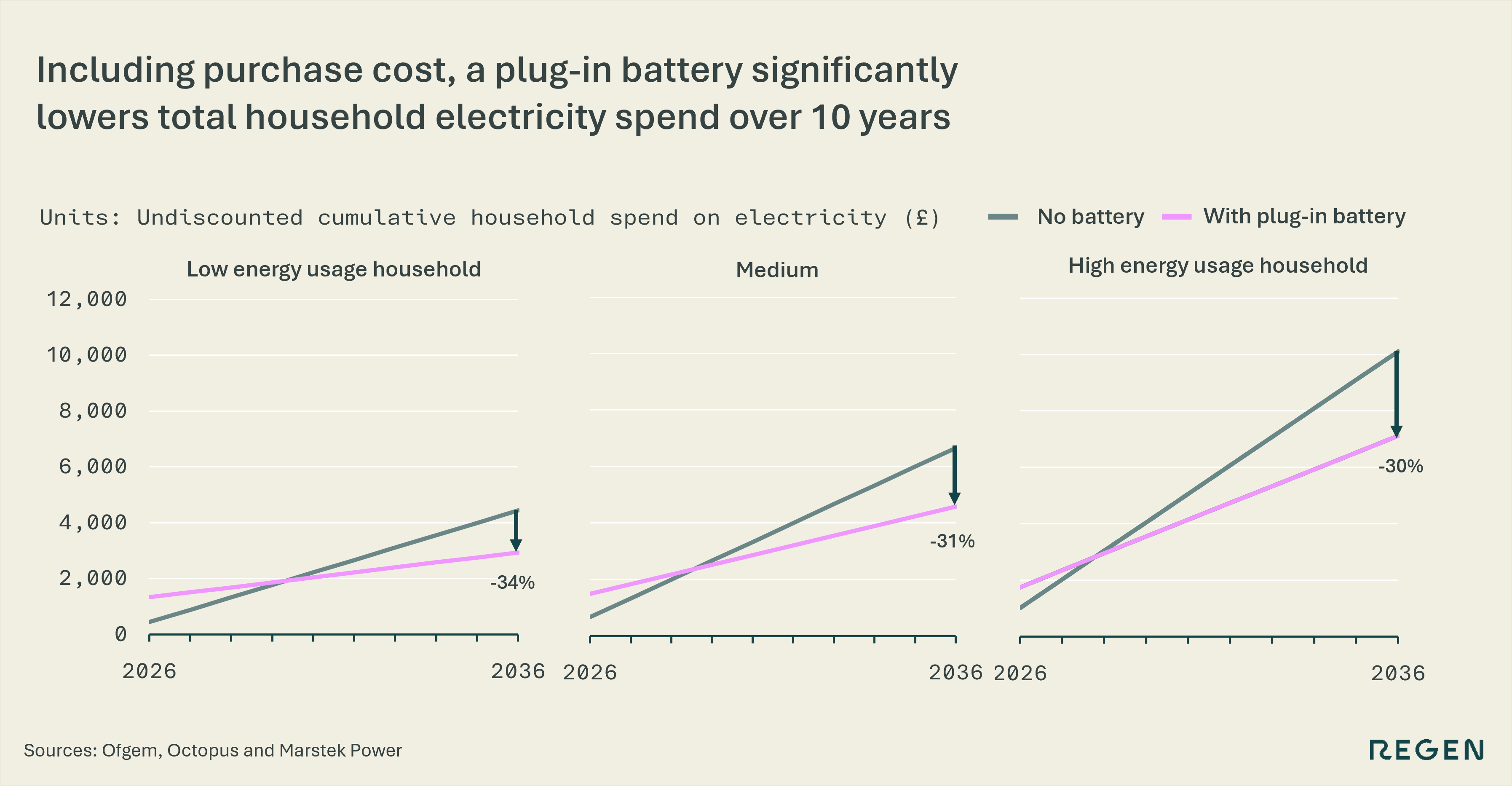
The charts below show Regen’s analysis of cumulative energy spend over 10 years for low-, medium- and high-energy households, comparing two scenarios: a single 3 kWh plug-in battery on the Octopus Go time-of-use tariff against the same household with no battery on a flat-rate tariff. In each case, the battery pays back from around 2.5 years onwards, with 10-year savings reaching up to £2,400 for the high-energy household.
Cumulative energy spends for low-, medium- and high-energy households. A low-energy household may be a flat or one-bedroom house and a high-energy household represents homes with four to five bedrooms and occupants. Typical consumption values from Ofgem were used and it was assumed only one 3 kWh plug-in battery was installed for each case (Ofgem, 2026).
Whether a plug-in battery saves money depends on several factors, including the choice of tariff, the battery size and the extent to which other household demand falls in off-peak periods of a time-of-use tariff. Figure 2 shows cumulative energy spend over 10 years, with and without a battery. The shaded band shows the range of outcomes across different battery sizes and proportions of demand falling in daytime higher-priced periods. Households that can shift demand to off-peak periods and utilise larger, or multiple, batteries could reduce their total costs over 10 years by 30-34%.
Cumulative energy spends for a range of battery and energy usage pattern configurations. Values are based on the Octopus Go time-of-use tariff and assume a ypical medium-energy two to three-bedroom household.
Caveat: for this analysis we have assumed no change in electricity tariffs. While this is unlikely, there is little consensus on the direction of future electricity prices. If tariffs increase, savings from purchasing a battery are likely to be greater.
Who benefits?
Plug-in batteries are low-cost, require no permission to install and can be removed and taken to the next home. This means they can extend the benefits of batteries and smart tariff arbitrage to a range of consumer groups and home types that are currently excluded from the market for traditional home battery systems.
These include:
The 9 million rented households in Great Britain who typically cannot make structural modifications to their property
The c. 6 million flat and apartment households who often lack the space required for a professionally installed unit
Low-income households, for whom the combined hardware and installation cost of a fixed system remains out of reach. 11.4m households are in the bottom 40% of incomes.
After accounting for overlap, these households represent in the order of 12 to 14 million households, or close to half of all households in Great Britain. Plug-in batteries would enable a much wider share of the country to feel the energy transition includes them, extending its benefits and sense of belonging well beyond more affluent owner-occupiers.
Energy system benefits
In addition to the bill reductions for households that purchase them, plug-in battery systems can deliver system-wide benefits. Under a rapid uptake scenario, by 2030 the total discharge capacity could reach almost a gigawatt and storage capacity over 4 GWh.
The Clean Flexibility Roadmap sets out a target of 23-27 GW of short-duration storage capacity by 2030. Starting from a position in 2026 with no installations, even with rapid uptake plug-in batteries would contribute a small portion of that 2030 target.
Plug-in batteries also won’t provide the full range of system services that larger battery systems can provide, such as frequency response, inertia or reactive power. If the 800 W discharge limit applied to plug-in solar is mirrored for batteries, the flexibility each unit can offer will be modest.
However, with the right tariffs and incentives, in the longer term they could provide an important contribution to peak demand reduction (lowering the cost of meeting demand, supporting capacity adequacy and avoiding network constraints) and supporting the integration of variable renewable generation. These benefits flow to all electricity consumers, not just those who own a battery, by lowering the costs that ultimately end up in everyone’s bills.
Chart shows the range between two illustrative GB-wide uptake scenarios for plug-in batteries developed by Regen. Assumptions for rapid scenario: 800 W discharge capacity, average 4 kWh storage capacity, uptake per year reaches 500,000 by 2030. Assumptions for slow scenario: 800 W discharge capacity, average 2 kWh storage capacity, uptake per year reaches 150,000 by 2031.
Many consumers would likely buy these alongside plug-in solar panels. Pairing the two brings added system benefits: it dampens the adverse impacts of plug-in solar (correlated generation on sunny summer days can lead to voltage rise on the distribution networks and challenges with low levels of demand on the transmission system) while also letting households capture higher value by using the power later in the day.
Plug-in batteries would also provide a level of household resilience by providing enough power to keep essential devices running power during power cuts. As 800 W is not enough to run an oven, households would still feel the impact of an outage, but it would be sufficient to power essentials like lights, Wi-Fi, and phones.
Safety and regulation
The reason plug-in batteries are not yet available in Great Britain is that existing wiring regulations were not designed for appliances to discharge power back into the household circuit. BS 7671, which governs electrical installations in UK homes, does not currently permit it.
Household wiring is protected from overheating and fire by circuit breakers in the consumer unit (the fuse board). Each circuit’s breaker has a lower rating than the wiring’s actual thermal limit, providing a safety margin. A ring main is typically protected by a 32 A circuit breaker (equivalent to 7.4 kW at standard UK voltage) and 20 A circuit breaker is used for radial circuits.
The problem with a discharging battery is known as load masking. Circuit breakers only detect the current flowing past them from the consumer unit and they cannot ‘see’ that a battery is plugged in. So when a battery discharges into a wall socket, the appliances on that circuit can draw power from the battery instead of the consumer unit – and the breaker continues to allow current up to its rating on top of what the battery is supplying. The wiring closest to the appliances can therefore carry more current than the circuit breaker is set to protect against. Exceeding the rated current could lead to the wire getting hot, increasing the risk of a fire. This is illustrated in the diagram below:
Capping plug-in devices at 800 W, as BS 7671 Amendment 4 does for plug-in solar, keeps the extra contribution small enough that this is unlikely to push the wiring beyond safe limits. The same regulatory barrier did apply to plug-in solar until March 2026, when DESNZ committed to change the regulations following a safety study carried out by Arceio. BS 7671 Amendment 4, published in April 2026, now provides the wiring regulation foundation for plug-in solar; a BSI product standard is expected by mid-2026.
A separate safety consideration is the risk of fire from the battery itself. For installed home batteries, this is addressed by PAS 63100:2024, which sets out fire safety requirements including separation from living spaces, ventilation and detection. These rules cannot translate directly to a portable plug-in device, so a plug-in framework would need to draw on product-level safety standards appropriate to domestic use.
Next steps for the government
It’s clear that plug-in batteries could be transformational for households in Great Britain that to date have been excluded from the benefits of home batteries. It’s positive that the government has announced plug-in solar, but it has left plug-in batteries in a grey area.
Regen suggests that DESNZ should now:
Commit to a date by which plug-in batteries will be legally available for use in Great Britain
Commission a rapid safety study for plug-in batteries, and work with the IET and BSI to update BS 7671 (the UK wiring regulations) accordingly
Sponsor a new product safety standard through BSI for battery fire safety in portable in-home devices (distinct from the PAS 63100 framework written for installed systems).
With the government commitment to cutting £300 from household energy bills looking increasingly out of reach, introducing a new product to the market that delivers meaningful bill savings at no cost to the Treasury should be one of the easier calls to make.



.jpg)


.jpg)
.png)
.png)
.png)
.png)
.png)
.png)


