




When Professor David Sergeant first conceived Feast for the Future, he didn’t start with an energy policy, a list of targets, or a technical brief. He began with a table, a meal, and a question: What parts of a better future are already within our reach — and how might we bring them forward, together?
Commissioned as part of the AHRC-funded “Imagining Alternatives” project, Feasts for the Future brought communities across Devon into a journey of creative hospitality. The project asked: how might communal meals act as a medium for shared imagination and alternative futures? Over 2018, local groups hosted a series of “utopian feasts” — interweaving local food, storytelling, art, and conversations about energy, climate, and community. The act of gathering, cooking, carving, sharing became a way to surface hopes, constraints, and collective potentials.
“Turning an everyday meal into a ‘Feast for the Future’ can be as simple as deciding to do it—and then just working it out as you go.” — Feasts for the Future website
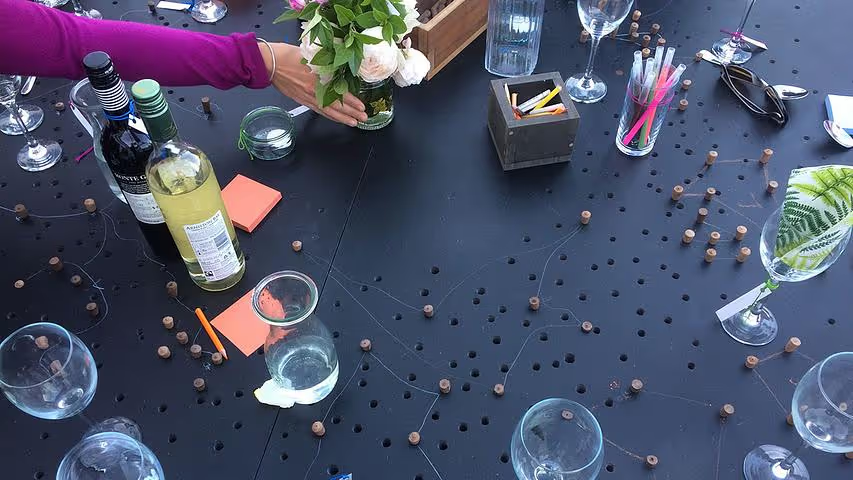
At the heart of the project was a specially designed feast table, carved by artist Barnaby Stone. As communities used the table, guests left marks, drawings, names, reflections — turning it into a cumulative and growing text of possibility. In each place, the core idea was adapted to local geographies, concerns, food systems, and energy conditions. No two feasts looked the same, and that diversity was central to the ethos: imagination is not universal, but situated.
The “feast as infrastructure” approach reframes how we think of energy and futures. It isn’t just about megaprojects or grid investments, but about connection, generosity, choice, rhythm, and the everyday. By bringing together food, art, and conversation, the project made the future feel accessible — not distant.
David reflects that one of the most powerful lessons of Feast for the Future was how readily people embraced agency when given permission. These were not passive audiences, but co-creators. The meals were not performances but conversations in time, shaped by the guests themselves.
He also acknowledges the emotional weight behind the conviviality. For communities already dealing with energy costs, climate anxiety, or infrastructure inequality, the project did not pretend justice would come easily. Instead, it created space for vulnerability, trust, and honest tension. In that tension, creativity becomes meaningful.
“Better futures often seem impossible, a hopeless dream. But what elements of that future are around us — waiting to be brought forward?” — from the Feasts for the Future project description
Because Feasts for the Future was part of the larger Imagining Alternatives research, it also connected to writing, lectures, and public workshops. The project did not end with the meals — it seeded ongoing networks, conversations, and shared resources to inspire others to turn ordinary meals into acts of imaginative possibility.
From Regen’s perspective, this collaboration taught us something subtle but profound: that infrastructure and imagination must co-land. Energy, in this frame, is not only about wires and turbines but about rhythm, trust, and belonging. The project showed that creative interventions can help communities pause, question, and reframe their relationship to what powers their everyday lives.
Working with David and Plymouth reminded us that the arts can help slow down complexity — not as distraction, but as essential reframing. In a sector obsessed with speed, efficiency, and scale, Feast for the Future countered with languor, care, and relationality.
Though the feasts were hosted in 2018, their influence continues. The project remains a living archive — a resource for others who wish to bring art, hospitality, and futures thinking into local places. Its concept endures: that each community might host its own feast, and in doing so, claim ownership of its energy story.
David’s own work with Net Zero Visions draws from the trust, curiosity, and embodiment of this project. For Regen, Feast for the Future remains a luminous early moment in our creative journey — a reminder that transformation begins not with blueprints, but with shared meals, carved wood, and imaginative questions.
“Sometimes, the most radical thing you can do is sit down together, eat well, and imagine.”
“Turning an everyday meal into a ‘Feast for the Future’ can be as simple as deciding to do it—and then just working it out as you go.”
Food is universal. It disarms hierarchy, creates intimacy, and invites everyone to contribute. A shared table can open conversations that policy documents never will.
Each feast used a specially carved wooden table, hand-made by artist Barnaby Stone.
As communities gathered, they carved drawings, names, and reflections into its surface — creating a living record of conversation, hope, and care.
“The table became a tangible memory of the conversations that had taken place — a kind of micro-utopia carved in wood.” — David Sergeant
1. Start small and specific.
Begin with one meal, one community, one question. Imagination grows locally before it scales.
2. Share authorship.
Every group adapted the feast to their place — different foods, venues, and themes. True participation means giving away control.
3. Embrace slowness.
Not all progress looks like momentum. Creative conversations need time to simmer.
4. Honour vulnerability.
Hope is fragile work. Space for honesty and uncertainty is what makes these encounters transformative.
5. Let the ordinary become extraordinary.
The feast showed that even small, everyday actions — eating, talking, listening — can become radical acts of imagination.
“Better futures often seem impossible, a hopeless dream. But what elements of that future are around us — waiting to be brought forward?”
Creativity doesn’t just interpret the future — it builds the scaffolding of possibility. Projects like Feast for the Future remind us that imagination itself is part of the energy system: a renewable force that sustains human agency.



