




When Emma Whittaker first connected with Regen through the Low Carbon Devon programme, she was already deeply embedded in the intersection between creativity, sustainability, and research. As Arts Lead at the University of Plymouth’s Sustainable Earth Institute, she had seen first-hand how creative practice could open up complex topics — from climate policy to renewable technology — and translate them into something people could feel, relate to, and act upon.
Her work with Regen was modest in scope but meaningful in insight. She helped the team with practical and logistical support during their first Art Lab — a pilot programme designed to bring together artists and energy experts to explore themes such as heat and community energy. “It wasn’t an artistic collaboration in the traditional sense,” Emma recalled. “My role was more about providing a space, hosting the exhibition, and supporting promotion. But even from that distance, I could see the potential.”
For Emma, what stood out most was not the scale of the project, but its ambition. “When I first heard about the idea of the Art Lab, I thought it was brilliant,” she said. “Artist residencies are always valuable — they give creatives time, space, and context. What made this one different was that it was embedded in a world that doesn’t often work with artists: the energy sector.”
Emma was intrigued by Karenza Sparks’ commission on the theme of heat. “I thought her work was interesting — she’d developed characters to personify energy concepts, making something technical and abstract more relatable. It’s a well-known idea — using character and story to engage people — but she gave it warmth and individuality.”
Looking beyond the pilot, Emma emphasised the importance of networks in amplifying the impact of creative energy work. “What makes these collaborations powerful is not just the individual projects,” she said, “but the connections between them. If artists, community groups, and organisations can share experiences and support each other, you get a multiplying effect.”
She suggested that future versions of programmes like the Art Lab should include collective structures — advisory groups, shared learning sessions, and national visibility. “That kind of framework allows people to publicise each other’s work and draw on each other’s learning,” she explained. “It magnifies impact and helps everyone feel part of something larger.”
Reflecting on her experience leading the Low Carbon Devon programme, Emma identified a key insight: collaboration works best when it builds on existing strengths. “I was always looking for where there was already funding, activity, or momentum in the community,” she said. “Then I’d approach those groups and ask: how can we help you communicate this through creativity?”
She believes the same principle applies to energy and climate partnerships. “It doesn’t have to be fine art or avant-garde,” she noted. “Craft, design, music — all of these offer ways to translate technical sustainability themes into something tangible and human.”
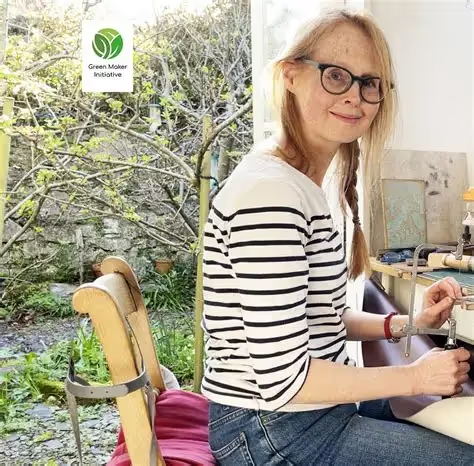
One of Emma’s observations was about the role of craft in sustainability. “Craft is such an interesting space for energy,” she said. “Makers are constantly engaging with materials, with energy use, with circular economy principles — often without calling it that. Many already have solar panels or heat pumps in their studios. It’s a lived relationship with sustainability.”
One of Emma's favourite success stories from her involvement with the Low Carbon Devon programme was the development of The Green Maker's Initiative which champions sustainable craft: materials, methods and techniques. - Find out more here.
She sees potential for future Art and Energy programmes to collaborate with organisations like Make Southwest, where craftspeople are already exploring green production, local materials, and renewable energy in practice. “It’s tangible. It’s place-based. And it’s part of everyday life — which is exactly what we need the energy conversation to be.”
Emma is pragmatic but hopeful about the future. She acknowledges that arts-and-energy collaborations often operate at the margins of both sectors, but she sees this liminal space as fertile ground for innovation. “These projects might feel small,” she said, “but they’re quietly changing how people think. The arts give us the language and emotion to navigate complexity. That’s something policy alone can’t do.”
Looking ahead, she believes that the next step is not just more projects, but better infrastructure for collaboration. “We need frameworks that allow artists and sustainability practitioners to meet as equals, with shared goals, proper funding, and long-term networks,” she said. “That’s how the work becomes visible, credible, and ultimately transformative.”
The Low Carbon Devon programme was structured around research, enterprise support, carbon reduction, and knowledge exchange. One of its standout findings was that creative communication and cultural engagement helped the programme “punch above its weight” in terms of reach and impact.
Creative and cultural approaches — from storytelling to visualisation — made complex technical themes more accessible and memorable. The arts proved to be a vital bridge between data, research, and lived experience.
A lasting legacy of the programme was the creation of the Sustainability Hub at Kirkby Lodge — a low-carbon retrofit that continues to host events, exhibitions, and collaborations.
This demonstrates the value of coupling creative and sustainability initiatives with physical, visible infrastructure. When creativity is built into the fabric of an organisation or a place, it endures beyond the life of a single project.
The programme facilitated dozens of collaborations between researchers and enterprises, including many within the creative industries.
This affirmed that culture is not peripheral to the low-carbon transition — it is a sector in its own right. Design, art, and storytelling are legitimate partners to technical innovation and policy development, helping to humanise and contextualise complex change.
The “Future Shift” internship programme placed graduates with SMEs to work on sustainability projects. These placements not only provided practical carbon reduction support but also gave participants confidence and leadership skills.
For arts and energy initiatives, embedding creative practitioners, students, or interns inside existing organisations can build mutual understanding, spark innovation, and expand capacity on both sides.
Low Carbon Devon ran over 90 events and reached thousands of participants. The evaluation emphasised that the success of the programme depended as much on knowledge exchange and visibility as on technical outputs.
For creative energy projects, this is a key lesson: it’s not enough to make great work — it must also be seen, shared, and discussed. Strategic communication and dissemination are essential to lasting impact.
Many of the partnerships formed during the programme continued after the funding period ended, showing that genuine collaboration can outlast project timelines.
This highlights the importance of designing for legacy from the outset — building long-term relationships, embedding creative practice within institutions, and planning for sustainability beyond grant cycles.
While engagement in Plymouth and South Devon was strong, rural and peripheral areas were harder to reach.
This shows the need for creative and low-carbon programmes to consider access and inclusion — using local partnerships, digital participation, and satellite events to extend reach and relevance.
Although quantitative targets were exceeded, the report acknowledged that cultural change takes time and is difficult to measure.
This is a familiar challenge for creative sustainability work. Artistic and cultural interventions often work at the level of mindset, emotion, and narrative — their impact emerges gradually.
Evaluating this kind of change requires a mix of qualitative and quantitative approaches, capturing both data and stories over time.
The Low Carbon Devon programme demonstrated that creativity is not an add-on to sustainability — it is an essential ingredient.
Arts and culture make complex ideas relatable, build resilience and imagination, and turn abstract policy goals into shared human stories.
Future collaborations between the cultural and energy sectors should build on these insights: embedding creativity early, resourcing it properly, and treating it as a strategic partner in the transition to a low-carbon world.
You can find out more about the Low Carbon Devon Programe here.



