




Editor’s note from Regen
In 2016, Regen had the privilege of collaborating with artist and producer Richard Povall, Director of Art.Earth Books, on Feeding the Insatiable — an international gathering at Dartington exploring the real and imagined narratives of art, energy, and the environment for a “troubled planet.”
The conference was unlike anything else in the energy world at the time. It blended performance, dialogue, and scholarship in equal measure, creating space for artists, scientists, and energy practitioners to meet not as representatives of sectors, but as human beings facing shared uncertainty.
For Regen, it was a formative experience. It showed us that creativity could reframe energy not as a technical field but as a human one — rich with emotion, language, and story. Richard’s approach to convening and publishing has shaped much of our Art and Energy work since: encouraging curiosity, risk-taking, and collaboration as tools for transformation.
The reflection below draws on Richard’s perspective as Director of Art.Earth and producer of Feeding the Insatiable, exploring how gatherings like this nourish both imagination and action in times of ecological crisis.
Feeding the Insatiable — Creativity, Connection and the Art of Gathering
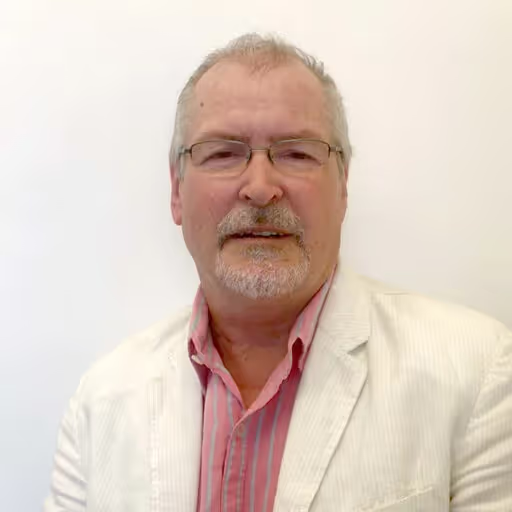
When Richard Povall talks about bringing people together, he often describes it as “creating the conditions for surprise.” As the founding Director of Art.Earth and Producer of the Feeding the Insatiable conference, he has spent decades exploring how artists, scientists, and communities can meet around urgent environmental questions — not to solve them, but to live with them more meaningfully.
“Whenever you bring people together, something happens,” Richard says. “You can never know quite what, and that’s the point. It’s about listening for what emerges when you stop trying to control the outcome.”
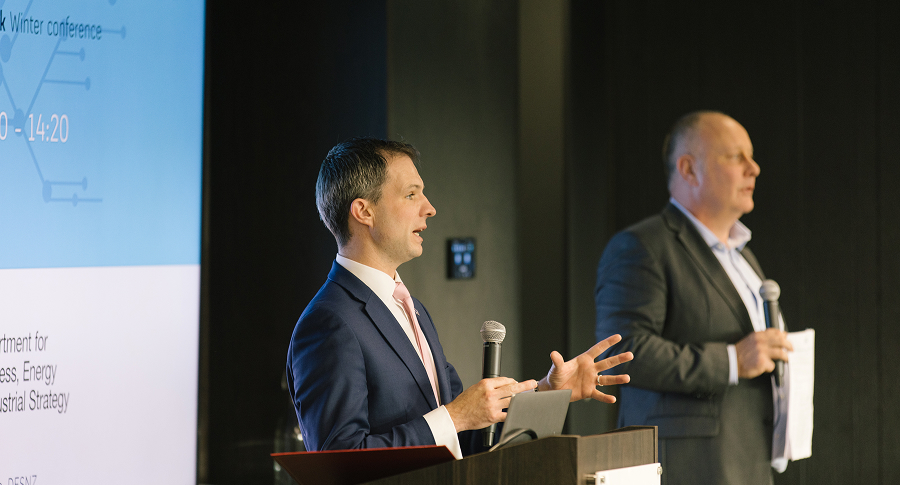
That philosophy shaped Feeding the Insatiable — a gathering co-designed with Regen and hosted at Dartington in 2016. It brought together artists, researchers, and energy practitioners to explore real and imagined narratives of art, energy, and the environment. The event — part conference, part performance, part experiment — embodied Richard’s belief that the best insights come when unlikely people share a room.
“If you can get people who are not used to seeing each other into the same space, and if you make that space generous and inspiring enough, you’ll get something genuinely new,” he reflects. “That’s where collaboration really begins.”
The Art of Meeting
For Richard, the act of convening is itself a form of creative practice. “It’s not about the gallery, or the artwork,” he explains. “It’s about the meeting — the system you build that allows something new to be said, something to be felt together.”
He sees his role as a kind of choreographer of encounter — not directing outcomes, but tending to relationships, dynamics, and the language people use to communicate across disciplines. “If you start with a message, you often end up preaching,” he says. “But if you start with curiosity, with real attention, then everyone learns something — including the artist - including the scientist.”
This emphasis on open-ended process is central to Art.Earth’s ethos. It values slow scholarship, emotional intelligence, and cross-pollination between creative and scientific practices. “We’re living in an age of tipping points,” Richard observes, “in both good and bad directions. Connection — real connection — is what keeps us from sliding into despair.”
“Start with curiosity, not with a message.
If you start with a message, you end up preaching.”
Collaboration as Craft
Richard’s collaboration with Regen and other partners taught him that creative energy work thrives on mutual respect and shared experimentation. “When you get artists and engineers, or community organisers and academics, in the same space, no one has the full picture. That’s where it gets interesting,” he says.
He recalls that the most valuable exchanges often came not from presentations, but from conversations in hallways and over coffee. “The quality of the meeting matters as much as the content,” he explains. “You need generosity, trust, and time. Those are your raw materials.”
And yet, he acknowledges that these gatherings take emotional labour. “Doing this work can be exhausting,” he says. “You’re holding space for different expectations, different languages, and different ways of knowing. But when it works, it’s transformative — not just for the participants, but for the communities and ecosystems that ripple out from them.”
Beyond Events: Capturing What Emerges
As both a curator and a publisher, Richard has long been interested in how learning from such encounters can be documented — without “flattening” it into policy-speak or academic prose. Through Art.Earth Books, he has sought to publish creative reflections that honour the voice and texture of the work.
“We need to bring value without bringing weight,” he says. “The writing should be light on its feet — something that carries insight without closing it down.”
In that spirit, Feeding the Insatiable didn’t end when the lights went out. Its legacy continues in the relationships it seeded — between Regen, Art.Earth, and a constellation of artists now working at the intersection of energy, ecology, and imagination.
Richard sees this as essential: “The value of an event isn’t just in what’s said on stage. It’s in what continues afterwards — the quiet influence, the crossovers that happen later in different contexts.”
The Value of Uncertainty
Asked what advice he’d give to others designing creative energy work, Richard smiles. “Invite people into a question, not a conclusion,” he says. “That’s where the energy is.”
He believes that creativity and community energy both depend on trust — and that trust is built through conversation, not consensus. “Artists and energy practitioners aren’t so different,” he reflects. “Both are working with invisible forces. Both are trying to make the unseen seen.”
For him, the role of gatherings like Feeding the Insatiable is not to fix the world but to keep the conversation alive, to resist the drift toward cynicism or oversimplification. “In the end,” he says, “what matters most is that we keep meeting — that we keep making spaces where people can think, feel, and imagine together.”
“Artists and energy practitioners aren’t so different.
Both are working with invisible forces.
Both are trying to make the unseen seen.”



