


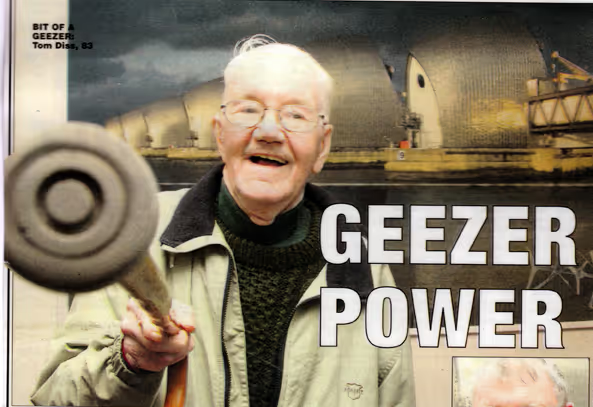


When artist and activist Loraine Leeson and a group of older men from East London – known fondly as The Geezers – first began exploring tidal power on the River Thames, none of them imagined that their small experiment would evolve into Active Energy, a twelve-year collaboration recognised with Regen’s Arts and Green Energy Award.
For Loraine, the award was more than a trophy.
“It was fantastic having that work recognised,” she says. “Projects like ours often sit outside the art institutions. When you work at the edges, you risk being written out of history. That award gave us visibility – and it gave The Geezers a real boost.”
The project’s success helped change perceptions of what community-based, environmentally focused art could achieve. Active Energy went on to win the Times Higher Education Award for Knowledge Exchange, became a Research Excellence Framework (REF) impact case study, and inspired international collaborations – from water-conservation projects in Rajasthan to trauma-recovery work with children in Kashmir.
“All of that came out of Active Energy,” Loraine reflects. “It showed that artists could bring new methods and understanding to scientific and social challenges.”
Loraine’s work reminds us that “energy” is not just a technical or physical force — it is social, emotional, and collaborative.
Through Active Energy, participants explored power in all its senses: renewable energy and the technologies that harness it; the energy of collaboration and imagination; and the inner energy that fuels motivation, curiosity, and hope. The project turned a tidal turbine into a conversation about ageing, innovation, and agency.
Loraine describes how the arts can help people “find their way into change through identity and self-expression.” For her, creativity isn’t just a communication tool — it’s a catalyst for intrinsic motivation. The process of making, experimenting, and imagining together activates the same human energy that drives social transformation.
As Active Energy grew, so did Loraine’s conviction that socially engaged art can change lives — not through spectacle, but through participation.
“When you create with people, not for them, you open up a space where knowledge and care flow in both directions,” she explains.
Her experiences as an artist-researcher have also exposed the fragility of this work within institutions. Despite awards and accolades, she has watched as social practice and community-arts courses have been cut from universities, replaced by narrower interpretations of fine art. Yet her response has been characteristically creative: to build new networks outside formal systems.
Loraine now leads the Social Art Educators Forum, an international community of 170 artists and educators across 27 countries who meet monthly to exchange ideas and mutual support. It thrives without funding, sustained entirely by shared enthusiasm.
“It’s proof that energy doesn’t just come from resources,” she says. “It comes from connection.”
Loraine believes it’s vital to nurture emerging artists who want to engage with environmental and social issues but don’t know that this kind of practice exists.
“Students are desperate to do work that matters,” she says. “But many don’t know they can. They’re not taught that art can be a tool for change.”
Her proposal? Introduce a student award for creative, participatory, environmentally focused projects. Such recognition, she argues, would legitimise this field for both students and institutions and seed a new generation of socially and ecologically conscious creators.
Looking back, Loraine sees the Green Energy Award from Regen as part of a lineage that needs to continue.
“It meant a great deal to have our work recognised by people outside the art world — by an energy organisation,” she recalls. “That kind of crossover is what we need more of. It validates both sides.”
Her admiration for Regen is warm and genuine:
“It’s a place full of hope and energy. Exactly where art should be.”
Loraine continues to share her experience with universities, community organisations, and businesses. Her talks and workshops help people explore creative ways to communicate complex ideas, build collaboration, and feel more connected — and hopeful — about the climate and energy transition.
“Projects like ours often sit outside the art institutions. When you work at the edges, you risk being written out of history.”
— Loraine Leeson
“Energy isn’t just technical — it’s social, emotional, and collaborative.”
“Recognition from the energy sector helped bridge a gap that’s too often left open.”
“The work continues, powered by connection rather than funding.”



