The Geoprint for Energy Club Connections and Operations (GECCO) project is exploring how a new flexible ‘Geoprint’ connection arrangement could enable new generation to connect in constrained areas of the grid, unlocking new renewable capacity, reducing network costs and strengthening community energy.
Across the UK, there’s growing frustration with how long it takes to connect new renewable generation to the grid. In many areas, the issue isn’t a lack of ambition or investment; it’s simply that demand is outpacing network growth. Reinforcing the grid takes time and money, and in the meantime, viable projects sit waiting.
So, what if part of the answer isn’t just building more network, but using what we already have more intelligently?
That’s where the idea of local energy balancing comes in. Rather than treating generation and demand separately, local balancing looks at how they can be coordinated within a defined area, matching supply and demand more closely in both time and place. This has the potential to reduce strain on the network, defer reinforcement and unlock new connections.
It’s an idea that’s gaining traction across the sector. Through the Geoprint for Energy Club Connections and Operations (GECCO) project, we’ve been exploring how a new flexible ‘Geoprint’ connection arrangement could enable new generation to connect in constrained areas of the grid.
We wanted to understand which local energy models could support meaningful local balancing and deliver real benefits for the network and communities. Here’s what we’ve learned so far…
1. Local balancing isn’t just theoretical – it works
One of the clearest findings from our review is that local balancing schemes can and do deliver tangible benefits.
Previous projects have shown that they can:
Reduce pressure on the network
Enable both new generation and new demand to connect
Deliver measurable financial value.
2. Not all local balancing models are relevant to GECCO
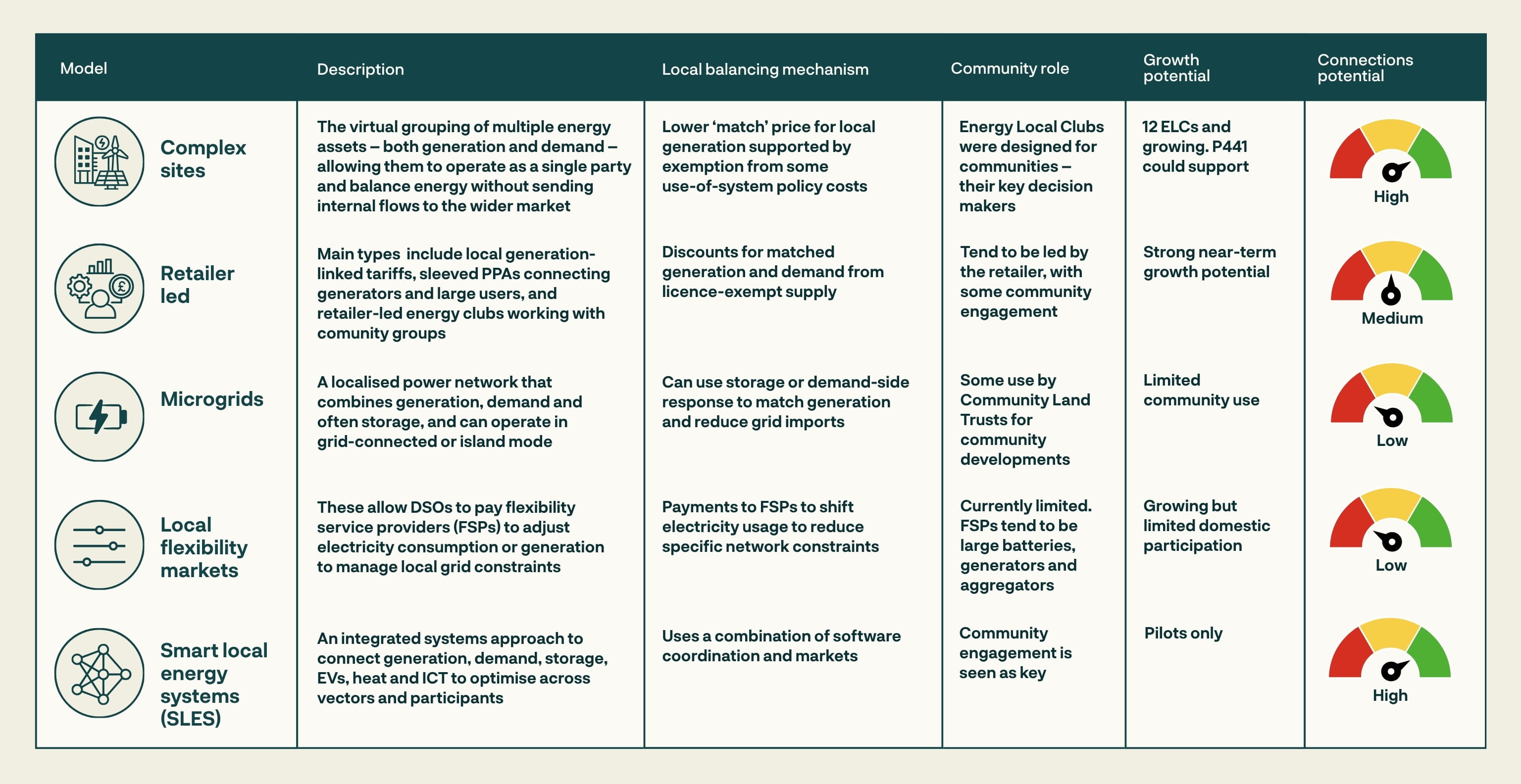
We took a step back to map the different types of local supply models emerging in the UK. There’s a lot of innovation happening, but these models vary in how they interact with the grid, and whether they can support local balancing in a meaningful, network-specific way.
To help make sense of this, we grouped the models into five broad categories:
What this shows is not that one model is ‘right’ and others are ‘wrong’, but that they play different roles.
Retailer-led models, including those using licence-exempt supply arrangements, are gaining momentum and can make it easier for customers to access local or green tariffs.
Smart local energy systems (SLES) offer a more integrated vision, linking power, heat, transport and digital optimisation, but are still largely at pilot stage.
Flexibility markets are opening up new ways to manage local constraints through price signals, but are not yet widely accessed by communities.
All of these play an important role in the transition. However, when we focus specifically on local balancing within a defined, constrained part of the network, one model currently stands out as particularly well aligned: community-led complex site arrangements.
In simple terms, these are locally organised energy ‘clubs’ operating within a defined area (often linked to a primary substation), where:
Generation and demand are actively matched
Communities play a central role in decision-making
Participants can respond directly to local system conditions.
That tight link between local behaviour and local network impact is what makes them especially effective for local balancing and why they should be of interest to the networks.
3. These models exist, but they’re still early-stage
Energy Local has already demonstrated the model in practice, with multiple operational clubs and more in development. New entrants are emerging, and interest from community energy groups is strong.
Regulatory changes are also moving in the right direction, with reforms expected to make these arrangements easier to set up and operate.
The most recent Strategic Innovation Fund challenges also include a goal to “prove the viability of autonomous local balancing and optimisation of networks at every level by 2034”, providing both strategic backing and funding.
But it’s still early days. Growth is happening, but not yet at the scale needed to make a system-wide impact.
Elevating the role of community energy
With Community Energy Fortnight drawing to a close, it’s worth reflecting on what this could mean in practice.
Community energy projects have long faced challenges around grid access and viable business models. What GECCO highlights is that community-led approaches could play a much bigger role; not just as participants in the system, but as part of the solution to its constraints.
These models:
Create a clear link between local generation and local benefit
Can improve perceptions of fairness around energy infrastructure
Give communities a more active role in the energy transition.
In short, they tackle both the technical and social challenges at once.
The opportunity and the challenge
There’s a clear opportunity here: local balancing could unlock new renewable capacity, reduce network costs and strengthen community energy.
But there are still barriers to overcome. These schemes can be complex to establish, require significant local coordination and depend on finding suitable sites.
Crucially, there is currently no straightforward way to connect new generation to a constrained part of the network, even where communities are willing to use local balancing to help create the additional capacity needed.
Where next?
GECCO is now moving into the next phase, working with community partners to test and refine these ideas in real-world settings.
The questions we’re left with are:
How do we scale local balancing in a way that keeps its local, community-led strengths while making it easier to deliver?
Can we create a standardised, flexible connection arrangement that allows communities to connect and balance local generation?
If we can answer these, local balancing could move from being a niche innovation to a core part of how we run the system.



.jpg)