New analysis from Regen shows that community-owned renewable generation across National Grid Electricity Distribution’s licence areas could scale from a current baseline of 265 MW to as much as 1.5 GW by 2035.
The modelling provides new evidence of the scale of opportunity for community ownership within the wider renewable energy pipeline and explores how different policy and market environments could influence how much of this potential is realised.
Community energy has an important role to play in delivering the UK's clean power ambitions and ensuring the benefits of the energy transition are shared more widely. With ambitious UK and Welsh Government targets for local and community energy, there is a growing need to understand what is needed to help realise these opportunities.
Regen has produced new modelling for National Grid Electricity Distribution (NGED) to estimate the potential growth of the community energy sector within its regions – the first time the Distribution Future Energy Scenarios (DFES) methodology has been applied to assess the future of community energy.
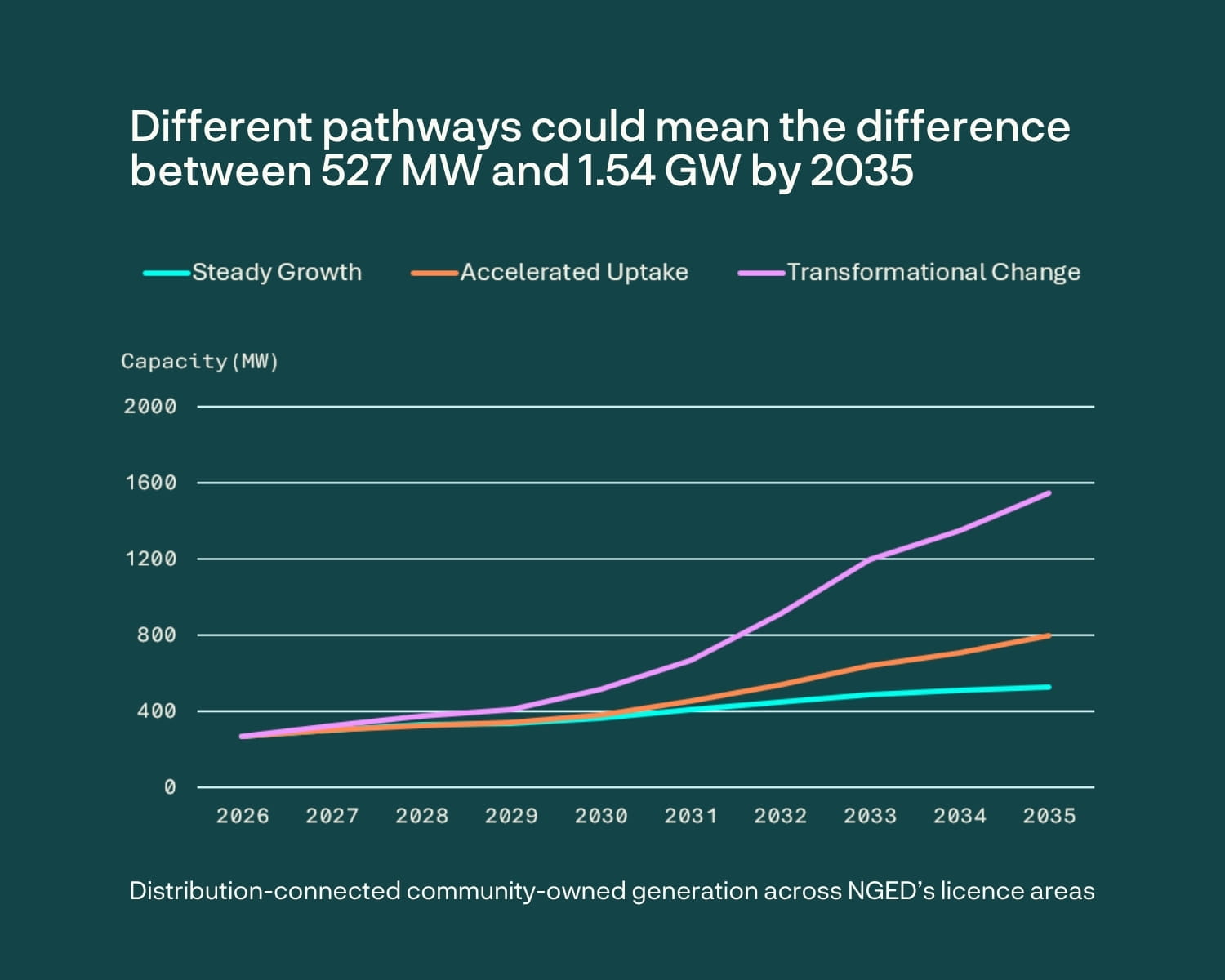
Community Energy Scenarios provides a new evidence base for policymakers, network operators and investors seeking to understand what it will take to deliver community energy at scale. The analysis shows that, under a transformational growth scenario, community-owned renewable generation across NGED’s licence areas could scale from a current baseline of 265 MW to up to 1.5 GW by 2035.
Modelling three possible futures for community energy
By testing different policy and market environments, the scenarios illustrate how community-owned generation connected to NGED's network could change over the next decade. The three scenarios modelled are:
Steady Growth: community energy project development continues at a similar rate to recent years.
Accelerated Uptake: stronger growth in community energy development, including a greater role for shared ownership.
Transformational Change: a significantly higher level of community ownership, supported by stronger shared ownership frameworks and capacity building.
Under Steady Growth, community-owned generation reaches 527 MW by 2035. Under the Transformational Change scenario, this rises to 1.5 GW in the same timeframe. The difference between these scenarios illustrates the scale of opportunity under more favourable conditions. This includes a greater role for Great British Energy and Ynni Cymru, particularly in ‘stewarding’ a shared ownership stake for communities in advanced projects, as called for in Regen's 2024 paper Sharing Power.
Ambition needs delivery mechanisms
Renewed commitments from the UK and devolved governments, alongside up to £1bn in funding for local and community energy from Great British Energy, have the potential to unlock significant value for communities across the UK, both in terms of clean energy generation and wider social and economic benefits.
Community Energy Scenarios demonstrates that there is significant potential to scale community ownership, but ambition needs to be matched by mechanisms that allow communities to participate in the energy transition.
Our findings suggest that higher levels of community ownership could be enabled by:
A clear definition of community energy: Our modelling shows that growth in community energy is constrained in the near term by grid capacity. A clear definition of community energy would enable reforms to allow differentiated treatment of these projects in the connections pipeline.
Stronger shared ownership frameworks: Our modelling shows that a combination of incentives, mandates and capacity building support, which the UK and Welsh governments are currently considering, could significantly increase the capacity of new and repowered energy projects owned by communities.
Dedicated revenue support: Access to finance and a lack of revenue support affects project viability. Our modelling shows that a fair, stable export price for community-owned electricity would give organisations the certainty needed to invest.
Greater capacity building: Community ownership presents an opportunity for more people across the UK to be able to share in the benefits of the energy transition. Our modelling shows that there are a significant number of organisations that could develop energy projects with the right support.
'Community-owned energy brings enormous social and economic benefits. While it is great to see the government’s ambitions for community energy, our analysis shows that, without urgent action, we are unlikely to be able to meaningfully scale up or bring these benefits to new communities. The role of Great British Energy will be crucial, injecting much-needed investment into the sector at pace and scale, but without government action, community energy organisations will face the same policy and regulatory barriers. The measures set out in our Transformational Change scenario are critical to the UK government's 8 GW target.' – Grace Millman, just transition and communities lead, Regen
A critical role for network operators
DNOs have an important role to play in enabling this opportunity. As the organisations connecting new renewable generation to the electricity system, they have a unique view of where future generation could be and where opportunities for community participation could emerge.
NGED is already supporting community energy organisations through events, guidance, case studies and community energy appointments. Regen and NGED are also working together to explore new approaches to connections and shared ownership for community energy projects through its GECCO and Matchmaker innovation projects.
This research builds on our previous ‘Future of Community Energy Study’, which explored the key trends, developments and innovations that will likely shape the future of community energy.
This new study provides a quantitative assessment of the potential scale of community ownership across NGED's regions. It suggests that, with the right conditions in place, over 850 MW of new community-owned generation could seek to connect during NGED’s next price control period, which covers 2028 to 2033. As NGED develops its ED3 business plan, Community Energy Scenarios aids its forward planning and helps ensure that the most appropriate support is available for community energy organisations.
'It is encouraging to see a report that sets out a range of growth scenarios and clearly illustrates the role community energy can play in the UK’s energy transition. Everyone should have the opportunity to contribute, and as the report makes clear, a transformational change is needed if the sector is to accelerate at the pace required to meet government ambitions. NGED is one of a number of organisations capable of enabling this progress. We recognise that further changes are needed to ensure community energy projects are supported by an appropriate connections process framework. Working alongside other community energy associations and stakeholders, we continue to advocate for a clear definition of community energy, which will provide a vital foundation for future regulatory and legislative development. – David Witherspoon, community energy manager, National Grid Electricity Distribution
How Regen is championing community energy
As momentum behind community energy builds, Regen continues to work with the DNOs, UK and devolved government and the wider sector to build the evidence base for action. Through analysis, stakeholder engagement and practical insights, we are helping shape the policies, markets and network approaches needed to enable community energy at scale. If you’d like to find out more about the analysis or our work supporting the community energy sector, please contact Grace Millman.