The rapid growth of data centres is creating a major new source of electricity demand in the UK. While some of the capacity currently sitting in the connections queue may never be built, the underlying trend is clear: demand is growing fast.
How that growth is powered could have significant consequences for the energy transition. Data centres could support investment in renewable generation, storage and grid infrastructure, and provide new sources of flexibility. Poorly located developments risk adding to peak demand, while those turning to fossil gas will increase emissions and lock in new fossil fuel infrastructure.
In this insight piece, we explore the options for a lower-carbon approach – from co-location with renewable generation and clean power contracts to storage, flexible connections and heat recovery – and set out what the government and planners can do to steer data centre growth towards a positive outcome for the wider energy system.
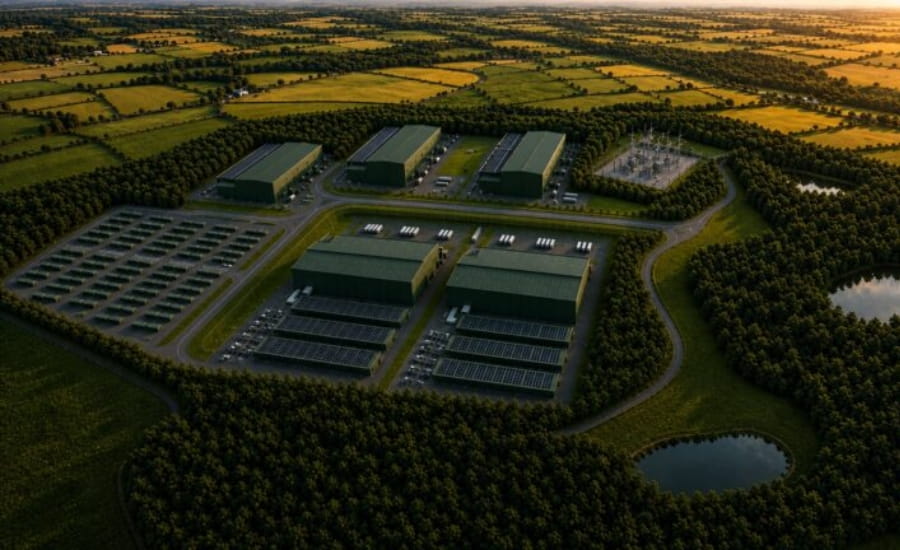
Xlinks’ proposed AI data and energy storage development at Alverdiscott, North Devon
Data centres have been increasingly in the spotlight recently. In August 2026, analysis by the campaign group Foxglove found that two planned data centres, Wapseys Wood in Buckinghamshire and Quest Park in Bedfordshire, could together draw 1.3 GW of power and emit more than 4.5 million tonnes of CO2 a year: more than ExxonMobil’s entire UK operations emitted in 2023, which amounted to 3.9 million tonnes according to Ember.
To understand the impact of fossil fuel generation over grid-based renewables, Regen has performed our own analysis for a theoretical 1 GW fossil fuel-powered data centre. Between 2.7 and 5.7 million tonnes could be emitted from a theoretical 1 GW site, according to Regen’s own calculations, depending on the type of gas generation used and load factor assumptions. Under a high load factor assumption, a data centre using a reciprocating engine would be over five times more carbon-intensive than the average grid emissions intensity, and 11 times more intensive than a renewables PPA with an assumed intensity of 50g/kwh.
Ofgem's figures show the demand connections queue grew from 41 GW to 125 GW between November 2024 and June 2025, with data centres accounting for 73 GW of that total; more recent public estimates put the data centre queue alone at around 100 GW. But we know a large share of this is speculative. In some cases, the same developer may be hedging bids across multiple sites, with some applications having little realistic prospect of being built. To address the issue, in July 2026 Ofgem opened a consultation proposing substantial upfront commitment fees and stringent delivery milestones aimed squarely at curbing speculative data centre bids and freeing up queue capacity for projects that are genuinely ready to proceed.
Even if we strip out the speculative noise that makes the pipeline seem much larger than it is, the underlying trend remains: data centre demand is growing, and growing fast. That growth presents both an opportunity and a challenge for the energy transition, depending on how, and where, it is delivered.
A good outcome would see data centre growth encourage investment in low-carbon generation, storage and grid infrastructure. New, large, relatively predictable demand could help spread the fixed costs of that infrastructure (pylons, substations, cables) across more users, provided data centres locate close to existing or planned connections and generation rather than requiring costly new build-out. Data centre demand could also become an additional source of flexibility, where workload allows, helping to balance the system and make the best use of low-carbon power when it is cheap and abundant, rather than simply adding to peak load.
A bad outcomelooks like the opposite: data centres sited in the wrong places, without adequate grid connections, adding inflexible demand to already-stretched peak loads and pushing up wholesale prices for everyone else. Faced with lengthy connection queues, some developers turning instead to new fossil fuel generation, locking in higher emissions and a growing dependency on imported gas at exactly the moment the UK is trying to move away from it.
And behind all of this sits a further, uncomfortable question: what happens to this new fossil infrastructure, and the grid capacity reserved for it, if the AI investment boom driving so much of this demand falters? Would we be left with stranded assets, and empty servers?
In this paper, we set out some of the options that could deliver a positive outcome that supports decarbonisation and lowers energy system costs. We also outline several recommendations for decision makers to make that positive outcome more likely.
Routes to decarbonisation
While some options will have a higher impact than others, the right decarbonisation route depends on a data centre’s size, location and ability to flex workload. The options below are broadly ordered from the most direct route to clean power through to the least, and from what we’d like to see more of, to what should only be considered as a last resort.
Location near existing or planned large-scale generation using private wire agreements
Where land allows, typically outside dense urban areas, data centres can site themselves next to large-scale wind or solar generation and connect via a private wire, avoiding network charges and potentially reducing the grid connection capacity that they need. In Harlow, a 40 MW solar farm is supplying Kao Data’s campus via a power purchase agreement. If the Harlow campus expands toward 150 MW as it intends, further renewable and storage capacity will be needed to hold that share.
In the UK, where available land is scarce, smaller modular data centres co-located with existing renewable sites, as Nodiac and PowerBank Corporation are doing across North America (with data centres in the 1-20 MW range), may prove easier to replicate.
Nuclear and space-based solar are among the more innovative solutions for large-scale low-carbon generation that can be consumed directly on-site. However, small modular reactors (SMRs) remain some years from meaningful UK deployment, and Meta’s 1 GW space solar pilot with Overview Energy is still at the demonstration stage, with completion expected in 2028. Both may eventually offer round-the-clock, low-carbon supply and, potentially, new sources of flexibility, but neither solution is developed enough to meaningfully decarbonise the current data centre boom, and neither should be relied upon, at least not as a near-term solution.
Bring your own power, via on-site generation
On-site generation is a useful contributor, particularly alongside storage, but it isn’t a decarbonisation strategy on its own, where limited land and available roof space means that computing power demand cannot be met just with on-site renewables. The amount of available roof space is often limited by the need to share it with cooling equipment. Planning applications may mention the presence of rooftop solar, as with the Apatura site near Ochiltree in East Ayrshire, Scotland, which will have an IT load of 200 MW and is anticipated to host a rooftop solar system. However, transparency around how much demand rooftop solar will likely match is hard to find, perhaps indicating the relatively small contribution being made.
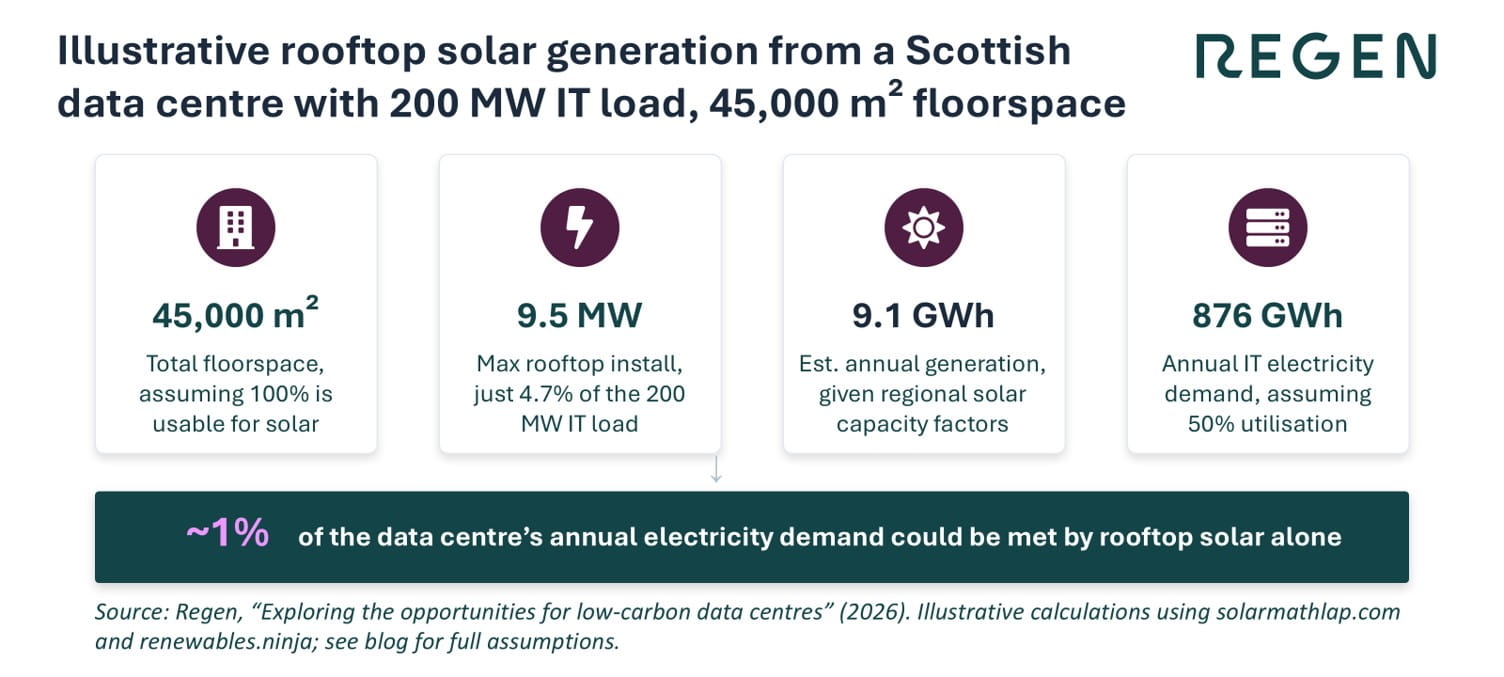
As a quick example, a 200 MW (IT demand only) single-story data centre with a floorspace of 45,000 m2, assuming optimistically that 100% of this is usable, could install up to around9.5 MW of rooftop solar (calculated using solarmathlap.com). If the development is multi-storey, this further reduces that potential.
We have calculated the potential rooftop solar generation of a data centre in southern Scotland to illustrate real-world solar generation conditions of a site like the one Apatura is constructing; a 9.5 MW solar array could realistically generate 9.1 GWh annually (calculated using renewables.ninja; Lat: 55.687, Long: -4.110). Assuming that the data centre has a 50% utilisation rate throughout the year, giving it an annual IT load of 876 GWh, just 1% of demand would be met by on-site solar generation.
We can tweak the assumptions all we want – it’s clear that rooftop solar alone will never meaningfully match the on-site demand of a data centre.
Buy your clean power from the grid using cPPAs and long-term contracts
Not every data centre can locate next to generation or build its own private wire. For the rest, buying clean power from the grid through corporate power purchase agreements (cPPAs) and other long-term contracts is the next best thing, provided it’s done properly. This is exactly what nLighten have signed up to do with Conrad Energy; in April 2024, a partnership was signed by the two companies. It differs slightly from a traditional PPA in that the agreement provides a provision for advanced hourly monitoring of asset-level consumption, enabling full transparency on how and where renewable energy is generated, and follows a model already tested by nLighten in Madrid.
Ideally, a data centre would purchase additional contracts for new generation rather than simply purchase paper REGOs or carbon credits after the fact. If PPAs are used, data centres can be active co-investors in renewable energy projects, as opposed to passive buyers of paper certificates. Regen has previously proposed that any supplier or high-energy user making low-carbon claims must produce a fuel-mix disclosure that is clear and explicit about the source of its energy, including the use of decoupled paper REGOs or other guarantee-of-origin certificates. Even with a strong cPPA in place, a data centre’s near-continuous demand still needs to be balanced against variable renewable output, which is where flexibility comes in.
Providing flexibility – storage and flexible demand
While on-site solar and wind generation is an attractive, direct route to decarbonisation, their variable nature and large spatial requirements cannot meet a data centre’s 24/7 demand, with developers stating that their best examples cover only up to 30% of the load. One solution is to co-locate data centres with battery energy storage systems (BESS), which can capture on-site generation, when this is in excess, or to import from the grid when prices are lowest and renewable energy is abundant or even constrained. Storage can also be used to provide flexibility services to the grid, as well as a backup power supply for the data centre in case of a network fault.
Apatura’s Freeport AI Energy Campus is a 250 MW data centre paired with an on-site 250 MW BESS planned to start construction in Scotland in 2027. The centre will use electricity from the national grid to charge the BESS with renewable electricity, ensuring the data centre remains fully operational in the event of any brief disruptions to the grid. The site was selected to take advantage of Scotland’s excess renewable energy generation, acting as a flexibility service and to ease grid constraints and help balance the grid.
In the south-west of England, Xlinks has proposed a 1.5 GW data centre development and 1.8 GW BESS in Alverdiscott, North Devon. The proposal has been met with backlash from local communities due to concerns on pollution, harm to wildlife and the impact on tourism. If it goes ahead, the project will be among the largest of its contemporaries across Europe and one of the highest electricity users in the country. Questions around fairness and public value of data centres are explored in this Regen Blog.
Elsewhere in the UK, Innova has proposed 10 data centre projects, half of which are planned to be paired with a BESS. Every project is specified at either 400 MW or 500 MW in capacity, with significant opportunities for carbon savings if the storage systems are charging with renewable electricity.
Long duration energy storage
There are a number of emerging long duration energy storage (LDES) technologies which could be a gamechanger for the data centre industry, both in terms of avoiding fossil fuels and maintaining an uninterrupted power supply. In 2025, worldwide LDES installations increased by 49% compared to 2024, which itself saw an increase of 806% compared to 2023. In the UK, the government has announced ‘minded-to’ support for 7.6 GW (137 GWh) for Window 1 applicants in the LDES cap-and-floor scheme.
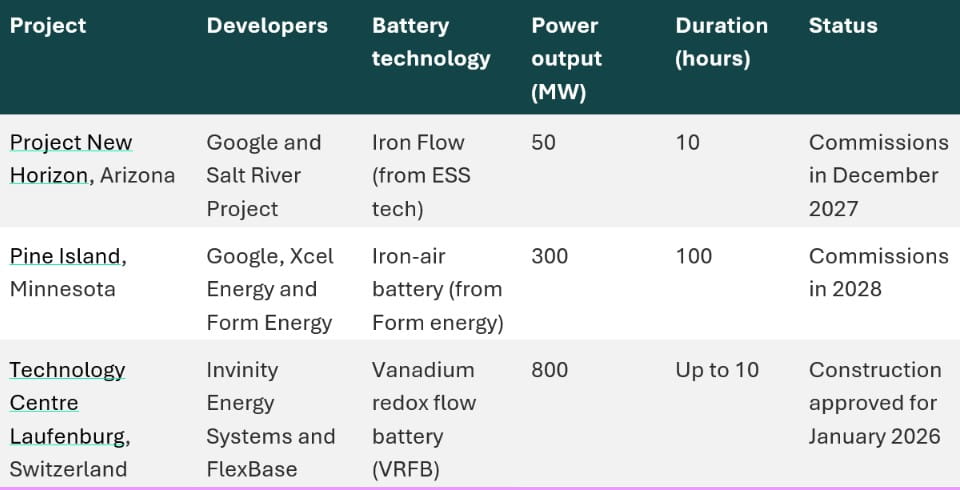
While many of the current LDES projects are, in fact, scaled-up lithium-ion battery storage projects, several groundbreaking technologies for LDES are being explored, including liquid air, liquid CO2, gravity-based systems, compressed air, iron-air and flow batteries. Iron air has the potential to store energy for 100 hours, with a 1.5 MW project in Cambridgeshire already being piloted in 2025 by Form Energy.
Several examples of LDES paired with data centres are being explored in the US, including a partnership between Google and Salt River Project on Project New Horizon, a 50 MW battery with 10-hour duration (50 GWh). The table below sets out just a few promising projects worldwide in partnerships with data centres.
While it’s exciting to see new and innovative technologies maturing, it is worth noting that falling lithium prices worldwide are making conventional lithium-based batteries more competitive for longer durations (see Wood Mackenzie). This is reflected in that fact that 11 of the 16 LDES cap-and-floor scheme minded-to decisions use on lithium-ion. Whether this is surpassed by other LDES technologies in the future will depend on factors like market growth, technology readiness and supply chains.
Land use presents another challenge for LDES business models, with many data centres aiming for populous areas with little space to develop on-site larger-scale battery storage facilities.
Enabling grid connections via flexible arrangements
As the UK’s power sector continues to decarbonise, importing electricity directly from the grid will have a lower carbon intensity than in countries largely powered by high-carbon sources. The UK should therefore be an attractive destination for any data centre developers who are interested in achieving a low carbon footprint.
The sudden increase in grid connection applications in the UK, however, does raise several grid planning issues. Networks face a dilemma: should they now commit investment in grid upgrades to meet the expected growth in data centre demand, only to risk applications not turning into real-life projects? The alternative is to wait and see but then be unable to offer data centres a rapid network connection. Electricity networks and data centre developers must work together to enable grid connections, whether this means paying developers to build their own substations or enabling non-firm or flexible connection arrangements to bypass current grid constraints and enable early connections.
Firm connections are built to withstand a single (N-1), or for larger loads a double (N-2), network fault under the Security and Quality of Supply Standards. This is a capital-intensive reinforcement that, given current queue congestion, can mean multi-year wait times. Non-firm connections instead offer earlier access to power (while grid upgrades are being made) by accepting curtailment risk, typically managed through Active Network Management (ANM) at distribution level or timed connection offers at transmission level, trading firmness of supply for speed to power.
It’s worth noting that flexible connections have not been well received by data centres, as the requirement to provide an uninterrupted power supply to customers makes flexible options seem risky. Some may only consider flexible options paired with on-site gas generation used as backup power for times when they have been told to turn demand down by the networks. This could mean that flexibility incentivises fossil fuel use to fill the gaps in available grid electricity.
Despite these concerns, flexibility has been demonstrated by the Emerald AI Trial at the Nebius data centre in London. During a five-day trial in December 2025, it demonstrated the use of demand-side response using Emerald AI’s Conductor software. The trial simulated various grid events which sent signals to the data centre to flex, which it then did. More than 200 simulated events led to real-time adjustments in power demand on-site. This led to a 40% reduction in electricity demand and critical workloads were able to continue operating.
The types of scenarios that were simulated included:
Reacting to spikes in demand from half-time football matches
Load-reduction requests of up to 10 hours
System stress event: 30% of load shed in 30 seconds
Notably, this response was driven by direct dispatch instructions rather than price signals. Much of data centre demand, particularly cloud and AI inference workloads, is largely insensitive to price, so a dynamic tariff alone would not have delivered the same result. Examples like this show how flexible power arrangements, underpinned by instructed rather than purely price-based demand response, could enable data centres to connect to the electricity grids faster.
Heat recovery options
Even if the energy supply to data centres has been decarbonised, data centres still emit unavoidable low-temperature heat, which is usually expelled by cooling systems to maintain optimal operating conditions. Rather than venting thermal energy into the atmosphere, why not reuse and recycle the heat in neighbouring buildings, industrial plants, or feed into district heating networks?
This is not a new idea. The technology is well established in Europe; Stockholm’s data parks supply waste heat to 35,000 apartments and Milan has data centres that even warm the iconic Duomo and Palazzo Reale. In West London, a district heat project, planned for a staged deployment from 2028 to 2040, will recover 17 MW (95 GWh per year) of waste heat from nearby data centres to heat 10,000 homes. Other heat networks currently under way, such as the Bristol Heat Network, will look to capture waste heat from data centres via energy centres in the future.
Some developers like nLighten have taken a novel approach pairing edge data centres with heat networks. When doing this, brownfield sites are prioritised; its Stuttgart site, for example, sells excess heat to Synergiepark Stuttgart. Through its sector coupling approach, nLighten bypasses administrative hurdles by owning and operating its own heat networks, which it co-develops with data centres. At its Eschborn site, nLighten partnered with the city to build an 800-metre supply line to a swimming pool.
While it sounds like a no-brainer that all data centre developments should be feeding their waste heat into nearby heating networks, this technology only makes sense when:
Considered at the planning and design stages, as retrofitting is difficult and costly
Heat demand is balanced with the availability of waste heat from the data centres. In some cases, colocation data centres would not be suitable, for example, as they have little to no control over their heat generation.
Decentralised heat recycling
With support from Ofgem’s Strategic Innovation Fund, UK Power Networks is testing a decentralised model. It’s investigating how mini data centres, about the size of a large heat pump and powered by solar panels, deployed in people’s homes, can be used to heat households and reduce heating bills. Still a developing market, this ‘cloud heating’ model is already gaining traction in Germany and the Netherlands.
Another option for decentralised data centres is direct heat offtakes from nearby facilities or new developments. Exmouth Leisure Centre in Devon presents an interesting business model. Deep Green installed a 28 kW immersion-cooled HPC system on the site, which captures heat from the servers and passes through the pool’s heat exchanger. Free heat is donated to the leisure centre while Deep Green benefits from the reductions in electricity bills. Under this model, approximately 62% of the gas requirements are replaced by server waste heat, resulting in 25.8 tCO2e saved annually.
The need for backup generation
Every data centre needs some form of backup power for the rare occasions when the grid fails, and realistically, that is mostly going to involve burning something. Our preference from a net zero standpoint is biomethane over diesel or fossil gas, or LDES when this becomes viable. We can also look at it as an opportunity: data centre backup demand could catalyse meaningful new capital investment in the UK’s biomethane production and grid injection infrastructure, which needs to scale considerably to meet the needs of other difficult-to-decarbonise sectors. However, in the long-run, LDES may reduce how often that backup capacity needs to run at all.
When it comes to fossil use for baseload power, Regen’s position is clear: no diesel, and no fossil gas should be used for baseload generation – not in the short term, and lot in the long term. This is wrong both as a business model, as it exposes developers to future carbon costs and stranded-asset risk, and from an energy security and resilience perspective, given the UK’s exposure to imported gas. The proposed SDC M40 Campus in Slough, which pairs 300 MW of IT load with a gas connection of up to 900 MW, is a clear example of the scale of the risk of locking in new emissions sources during a time of climate crisis.
That being said, we must be pragmatic. We already know that around 100 data centres have applied for gas network connections, but it’s not clear how many of these are for genuine emergency backup versus primary power supply – a critical transparency gap that must be addressed. In short, fossil gas should be limited strictly to backup, and even then, biomethane should be the preferred choice wherever it’s available.
Recommendations for government and planners
Getting to the good outcome described above won’t happen by accident. Based on this analysis, we think government and planners – from Ofgem to local planning authorities – should consider the following:
A 100% renewables obligation. Legislators should consider an obligation for data centres along the lines of the mandate Australia’s federal government announced in August 2026. Under this policy, all data centres must run on 100% renewable energy, backed by storage or gas firming. A comparably clear, non-negotiable direction of travel in the UK would remove much of the ambiguity developers currently navigate.
A moratorium on new data centres that intend to use gas generation as a baseload power source. Planning permission should not be granted to data centres that intend to run on fossil gas as a primary power source. Backup generation is a different matter (see above) – but newbuild proposals should not be able to plan gas in as their baseload supply.
Energy use transparency in planning documentation. Data centres should be required to disclose their intended power supply – on-site generation, private wire, grid connection type and fuel mix – clearly in planning documentation. Our own review of 152 UK data centre planning applications found that only 20 (13%) mention on-site energy generation technologies, and just 15 (9%) indicate whether the site intends an electricity or gas network connection at all. Without this information, neither communities nor grid planners can respond appropriately to what's actually being proposed.
Require data centres to pay for their fair share of upstream upgrades. Data centres should have deeper connections charges relating to electricity network upgrades that their connection specifically drives, rather than socialising that cost across all billpayers. This is the flip side of the fixed-cost-sharing benefit described in our introduction: data centres that genuinely relieve pressure on the system should benefit accordingly, but those that create new bottlenecks should bear the cost of resolving them.
Accelerated grid connections, without the fossil gas bypass. Data centres at risk of bypassing the connections queue via fossil gas need a genuine low-carbon alternative route to power: phased connections, flexibility-based (non-firm) connection arrangements, and support for developers to bring their own network. Ofgem’s proposed commitment fees and delivery milestones should help by freeing up queue space currently tied up by speculative bids – but speed to power needs to be available on low-carbon terms, or developers will keep reaching for the fastest option regardless of its carbon impact.
Further reading
Limitations and assumptions used
High-level calculations used in this blog are purely illustrative and do not attempt to represent actual or proposed on-site demand or generation, but rather illustrate how a typical project could affect energy and carbon footprints.
A 50% load factor was applied to all calculations used to determine future on-site energy demand from data centres. In reality, on-site power demand depends on many factors, including: which cooling system is used, the proportion of racks filled by customers, the types of workloads being performed (AI training, inference, cloud services), and the frequency at which workloads or services are being called. Regen’s own analysis of UK Power Networks’ data centre utilisation data revealed that average utilisation across all data centres connected to its network never surpassed c. 30%.
Emissions savings have been estimated based on the grid electricity carbon intensity from the Department for Energy Security and Net Zero’s annually published Greenhouse Gas Reporting Conversion Factors, 2026.
Gas emissions from Wapseys Wood and Quest Park: Regen has redone high-level calculations to estimate carbon emissions from both sites. Load factor assumptions of 40% and 70% respectively were used and compared, and only IT-related installed capacity, as announced in planning documentation, has been considered. A difference in emissions compared to electricity grid carbon intensity versus OCGT gas plant carbon intensity has also been calculated.