The rising cost of energy bills has been a constant in headlines of recent years, with a renewed focus since the start of the US war in Iran in February this year. In this piece, we take a look at how the fundamentals of this crisis put the government in a different strategic position to the Russia-induced bills crisis of 2022, what the government has already done in response and what the new Prime Minister should prioritise.
Energy prices have spiked again
The US war in Iran has provided another uncomfortable reminder of the exposure of UK energy prices to geopolitical externalities. The closure of the Strait of Hormuz has introduced a significant global supply shortage while also increasing the risk premium for shipping companies and insurers. A look at fossil fuel commodity prices paints a stark picture. At the time of writing (mid-July), prices had been easing as a result of a ceasefire and diplomacy. Unfortunately, this has ended in recent days and prices have begun to climb once more – showing we are very much not out of the woods.
Twelve-month fossil fuel price indices, year to 10 July 2026. Note: The bombing of Iran by Israel and the US began on 28 February 2026. Source: tradingeconomics.com
Naturally this has fed through to higher prices for people filling their cars and heating their homes, though as the UK endures what looks set to be its hottest year on record, pressure on household bills has not yet been as acute as some first feared. Prolonged conflict and instability into the winter could produce a different story, with most British homes still reliant on fossil fuels for heat.
This crisis is not a repeat of 2022
In 2022, after Russia’s invasion of Ukraine, we saw immediate and extreme pressure on energy bills. What’s different this time? Recent months may have seen a doubling in gas and oil prices, but these are relatively insignificant when compared to the fluctuations seen throughout 2022.
Five-year natural gas index, to July 10 2026
The reasons for this are complex, but one important difference is that Europe entered this crisis with a much more diversified gas supply than it had in 2022. Following Russia's invasion of Ukraine, Europe rapidly replaced a large share of Russian pipeline gas with LNG imports from a wider range of suppliers, particularly North America. Global LNG markets remain highly interconnected, so disruption to the Strait of Hormuz still feeds through to other prices via increased demand and speculation. Nonetheless, Europe has avoided the sudden loss of a dominant supply source that defined the 2022 crisis.
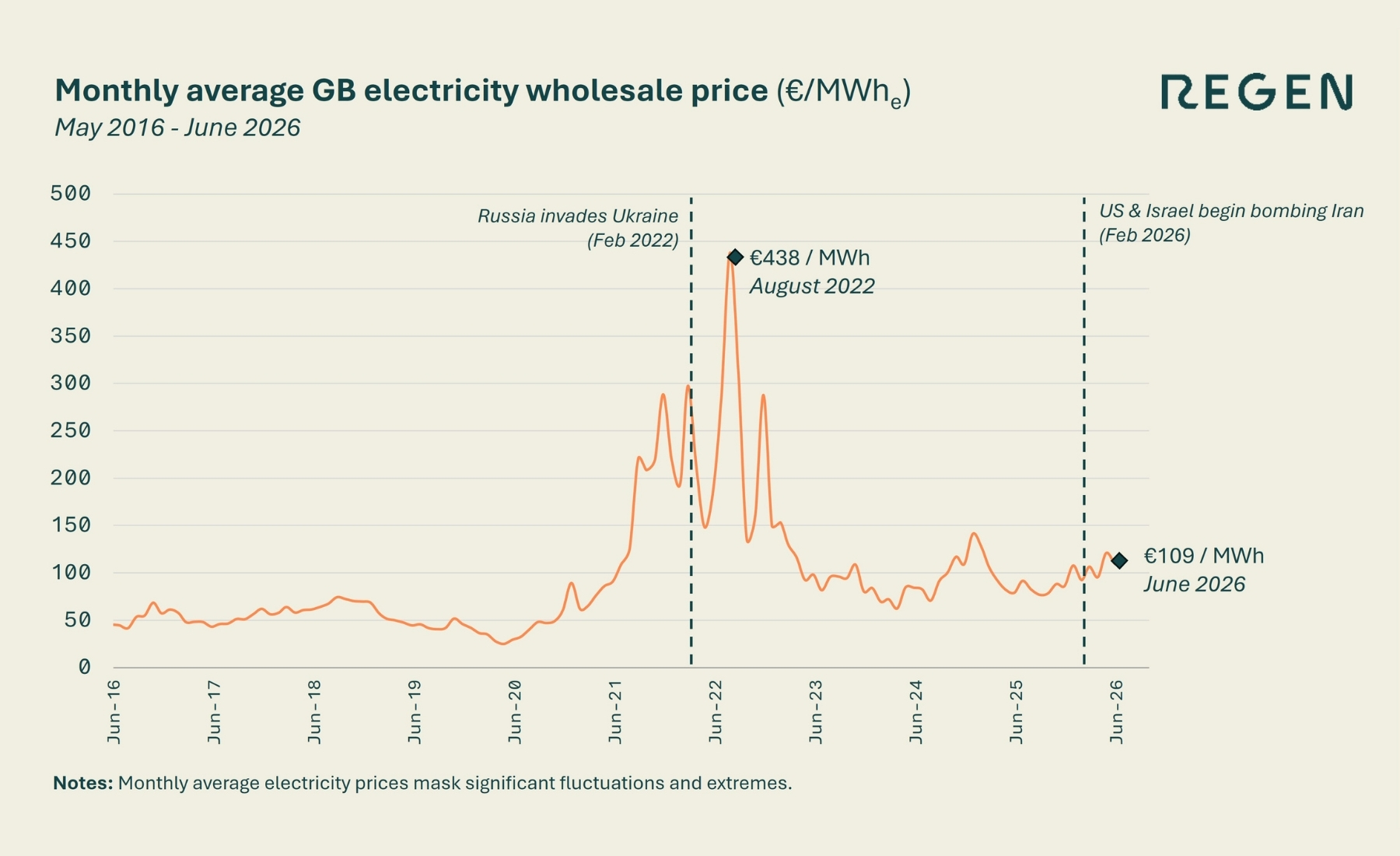
The wholesale price of electricity in Britain has also stayed far lower.
Monthly average GB electricity wholesale price. Source: ENTSO-e, via Ember.
We saw absurdly high electricity prices throughout 2022 and 2023. Electricity prices have risen this time, but nothing like the levels seen four years ago. Partly that's because the mechanics of the disruption are different and Europe’s gas supply is now much more diverse. But it also reflects changes to the electricity system itself: favourable weather and more renewable capacity has exerted downward pressure on wholesale prices (see Regen's new dashboard), while additional storage and interconnector capacity have further reduced the amount of expensive gas-fired generation needed.
In 2026, electricity prices have not risen as much as gas
Moreover, the increase in electricity prices so far has not been as drastic as that seen for gas since the start of the year (increased gas demand and adverse weather conditions could change that as we move into winter).
Comparison of normalised gas and electricity wholesale prices for 2026 YTD (Electricity data from Ember, Gas data from Investing.com)
Although electricity prices have not spiked as aggressively as gas, heating oil and road fuel prices so far in 2026, which is in part due to renewables, this will not change the reality for the many customers in the UK who may be unable to heat their homes properly because of gas and oil prices.
In simple terms, therefore, the long-term objective should be twofold:
Continue building a clean power system, with low-carbon generation, storage and interconnection to further insulate the electricity market from international fossil fuel prices
Electrify more demand to reduce the number of customers directly exposed to international fossil fuel prices and reduce the unit costs of electricity.
Despite the wording of the government’s press release, this isn't strictly about ‘splitting the market’. Fundamental wholesale market reform (such as implementing split market designs, for which there are many proposals) would be extremely complex, and the government has largely stepped away from those more radical options.
Instead, the approach taken for now is much more pragmatic, trying to shift price risk away from consumers and on to longer-term contracts.
The centrepiece is a new Wholesale Contract for Difference (WCfD) for existing renewable generators. Through this, generators are offered stable long-term revenues in exchange for giving up the upside when wholesale prices become very high. That gives investors greater certainty, while helping shield consumers from future spikes.
Alongside that, the government has strengthened the Electricity Generator Levy, or ‘windfall tax’. If generators choose to remain outside the CfD and wholesale prices reach extreme levels again, more of those excess profits will be taxed away.
So it’s essentially a carrot and stick approach. The carrot is revenue certainty through the Wholesale CfD. The stick is a reduced financial incentive to remain fully exposed to volatile wholesale markets.
The government's April policy package explained
Consumers may benefit from these changes, but not immediately. The first WCfD auctions aren’t expected until next year, so this isn’t support for today’s bills. Even then, the eventual benefit depends on three things:
Enough generators choosing to participate
Competitive auctions delivering low strike prices
The contracts genuinely reducing financing costs and market risk.
The changes to the Electricity Generator Levy themselves probably won’t raise very much additional revenue unless we see another prolonged period of exceptionally high wholesale prices – our analysis suggests the difference is relatively modest under normal market conditions. The government could, of course, further increase the marginal rate or reduce the payment threshold, though this may face resistance from generators.
Overall, though, Regen views these policies in a positive light. Rather than simply firefighting, government is starting to think about how we build an energy system that’s inherently more resilient to future price shocks.
Ongoing reforms are providing resilience
Outside of the government’s immediate response in the wake of the Iran crisis, there are several ongoing streams of long-term energy system reform which are working to improve our resilience to these sorts of risks.
Two years ago, the Labour government came in with a ‘clean power mission’ at the centre of its agenda. From the day-one decision to unblock onshore wind in England through to major reform processes on planning, grid connections, electricity market reforms and significant network build-out, there has been a huge amount of work. While some of the reforms have brought challenges and ministers have increasingly stressed that clean power is not ‘at any price’, there is no doubt the past two years have brought new drive to the energy transition, and we are starting to see the benefits as we look at the price dynamics in recent months.
The challenge now is to ensure that momentum is not lost in the transition to a new Prime Minister, but it's also about moving to the next phase of the mission: showing what clean power can deliver for people, places and the wider economy. Reformed National Pricing will remain central for the incoming government – read our priorities for that ongoing process here.
What else could Burnham do quickly?
With a new Prime Minister stepping into Downing Street today, energy prices, resilience and security will all be high on the agenda, and alongside the government’s long-term reforms, there remain several practical measures that could deliver more immediate benefits for consumers.
Plug-in technologies
One of the most compelling is enabling plug-in battery storage. The government has already committed to changing legislation to permit plug-in solar systems, but equivalent reforms for plug-in batteries have yet to follow.
This is a relatively simple regulatory change rather than a major spending commitment. Plug-in batteries are already widely available in countries such as Germany and Australia, allowing households to store cheap electricity generated during the day or purchased during periods of low wholesale prices for use later.
Regen’s analysis suggests this could reduce household bills by up to £150 per year, while also increasing system flexibility, reducing network pressures and helping absorb surplus renewable generation that might otherwise be curtailed. It represents one of the lowest-cost interventions available to government and is also an area where local authorities could play a significant role in supporting rollout, particularly among lower-income households.
Levies
The government could also continue shifting policy costs off electricity bills and into taxation. At present, electricity carries a disproportionate share of the cost of the energy transition, even as households and businesses are being encouraged to switch away from fossil fuels. The result is a perverse incentive: the cleaner and increasingly more resilient energy source remains comparatively expensive.
This matters especially in the context of heat – if a heat pump improves on the efficiency of a boiler by a factor of three or four but the price of electricity is three or four times higher than that of gas, it cancels out the benefit.
Moving a greater proportion of policy costs into general taxation would reduce electricity bills while making the system more progressive. The poorest households spend a disproportionate share of their income on energy – analysis from the MCS Foundation shows that low-income households spend more on levies than they do on basic food items. Meanwhile, households with direct electric heaters and boilers – who have higher electricity demand making them especially exposed to levies – are both significantly more likely to experience fuel poverty and pay substantially higher policy costs than households heated by gas.
Removing levies from energy bills can have a significant positive impact on businesses too, helping to stimulate economic growth, as evidenced by Energy UK and the CBI in their recent paper.
The government has already taken an important first step by moving part of the Renewables Obligation into taxation, but there is a strong case for going further. Analysis from E3G estimates that a more comprehensive reform could reduce average household electricity bills by around £120 per year, while lowering non-domestic electricity prices by around 20%. A logical next step would be exploring some of the highest-cost legacy revenue support schemes, such as FIDER CfDs, as explored in our recent paper.
Support for local energy supply
Another opportunity is to make it easier for communities, businesses and the public sector to buy electricity directly from local renewable generation. There is growing interest in local energy supply models, particularly among local authorities seeking to retain more of the value of the energy transition within their communities. Rather than creating new municipal retail suppliers, the greatest opportunity may lie in expanding collaborative procurement models, such as sleeved Power Purchase Agreements (PPAs), alongside more flexible local supply arrangements.
Done well, local energy supply can deliver a range of benefits beyond lower bills. It can improve fuel poverty outcomes, strengthen local economies, increase public support for renewable development and create a stronger connection between local generation and local consumers. Regen explored many of these opportunities in Power in Places: A Vision of Local Energy Supply, highlighting how local supply could become an important component of both economic growth and a just transition.
With Andy Burnham’s focus on devolution and so-called ‘Manchesterism’, local places may have a huge opportunity to take more ownership of their energy system and stimulate regional economic growth.
Supporting Power Purchase Agreements
More broadly, the government should continue to support the development of the corporate PPA market. Long-term PPAs provide businesses with greater price certainty while offering renewable generators a stable revenue stream, helping to unlock investment without relying solely on government support mechanisms. We welcomed the government’s response to the recent Corporate Power Purchase Agreement consultation, which recognised the important role PPAs can play in accelerating renewable deployment and improving energy resilience. A more liquid and accessible PPA market would complement wider market reforms by increasing opportunities for businesses and communities to benefit directly from low-cost renewable electricity. Read Regen’s response to the consultation here.
North Sea drilling licenses?
Calls to expand North Sea oil and gas production inevitably re-emerge whenever energy prices rise. Additional domestic production may provide some benefits for energy security, tax revenues and employment during the transition. However, it is unlikely to materially reduce wholesale gas prices or household energy bills. UK gas is sold into international markets, meaning domestic production does not insulate consumers from global prices.
More fundamentally, the North Sea is a mature, declining basin. There is no credible projection showing UK production increasing or even stabilising over the long term: the debate is over the rate of decline rather than a return to growth. Meanwhile the UK will remain a significant gas importer.
Therefore, even if using ‘home-grown’ gas has some merits, the key to energy security and resilience is a reduction in gas demand and increasingly relying on alternative energy sources. Indeed, if the UK and its neighbours could reduce gas demand, perhaps also increasing gas storage, we might reduce, or even eliminate, expensive and higher-carbon LNG imports. If we did that, it would then become meaningful to talk about the positive impact North Sea production could have on European gas prices.
Ultimately there is no single solution and the energy transition requires a cohesive long term strategy. But to try and get close, we asked some of Regen’s experts for what their policy priorities would be if they had a few minutes with Andy Burnham in the coming weeks.
Although individual responses naturally reflected people’s areas of expertise, there are several striking themes...
Table Contents
At a glance
Key recommendations
Continue building the clean power system. The experience of both successive energy crises has shown that every additional wind farm, solar array, battery and interconnector reduces the influence of international gas markets on electricity prices. Maintaining momentum on Clean Power 2030, strategic planning and market reforms remains fundamental to grow this resilience, both through renewable energy output and increased network capacity.
Accelerate demand electrification. Incentivising heat pumps, electric vehicles and flexible demand are often discussed as climate policies, but increasingly they are being discussed as resilience policies. Every household that switches from fossil fuels to clean electricity becomes less exposed to future geopolitical shocks. At Regen, we are particularly excited by the potential of low-cost plug in solar and batteries, and legalising plug in batteries should be an immediate priority for Burnham’s new government.
Make electricity the obvious choice. Electricity needs to become consistently cheaper than fossil fuels. Continuing levy reform, market reform and strategic network investment will help ensure households and businesses actually experience the benefits of an increasingly renewable electricity system through lower and more stable bills.
Empower local ownership and delivery. The transition will ultimately be delivered in places, not Whitehall – a theme which has been consistent in Andy Burnham’s messaging before becoming PM. While national policy is essential, local authorities, communities and regional leaders need the powers, funding and policy certainty to translate those ambitions into projects on the ground. Stable planning policy, the delivery of the Local Power Plan and greater devolved responsibility for energy will all be important if the benefits of the transition are to be realised locally. Alongside this, the government should continue removing barriers to local ownership and local energy supply. Models such as community energy, sleeved Power Purchase Agreements (PPAs) and other collaborative procurement arrangements can help keep more of the economic value of renewable generation within local areas, while supporting investment, strengthening public support for infrastructure and stimulating regional growth. Rather than simply hosting renewable projects, communities should increasingly have the opportunity to own, use and benefit directly from the clean electricity they produce.
Ensure the transition is delivered fairly. Finally, the transition must be seen to benefit everyone. While renewable generation is increasingly reducing wholesale electricity prices, many households (particularly those in fuel poverty) have yet to experience those benefits. Moreover, low-carbon technologies that enable households to benefit from flexibility and improved efficiency are typically expensive and therefore overwhelmingly owned by the affluent. Better targeted bill support, alongside longer-term reforms such as a social tariff, could ensure that the households most exposed to high energy costs benefit first. Lower emissions are great, but a truly successful energy transition will deliver greater resilience, lower bills, reduce fuel poverty and strengthen local economies.
The recent crisis is a reminder that the UK’s exposure to global fossil fuel markets has not disappeared. But it has also demonstrated that the energy transition is already improving resilience. The challenge for Andy Burnham is not simply responding to the next geopolitical shock, but ensuring that when it arrives, far fewer households feel its effects.



.jpg)


.jpg)
.jpg)
.jpg)
.jpg)
.jpg)


