


Two years ago, Labour came to power with an ambitious ‘clean power mission’ at the centre of its governing agenda. Now, with a change of leadership, we assess progress and what the next steps must be for the incoming Prime Minister.




Two years ago, Labour came to power with an ambitious ‘clean power mission’ at the centre of its governing agenda. Now, with a change of leadership, we assess progress and what the next steps must be for the incoming Prime Minister.
Back in July 2024, Regen set out a list of first steps for the incoming Starmer government that we argued would set the country on course to deliver its clean power mission. From a clear plan to reforming the planning system, grid connections and electricity markets, and embedding just transition principles throughout, we set out 18 actions to take within its first 100 days.
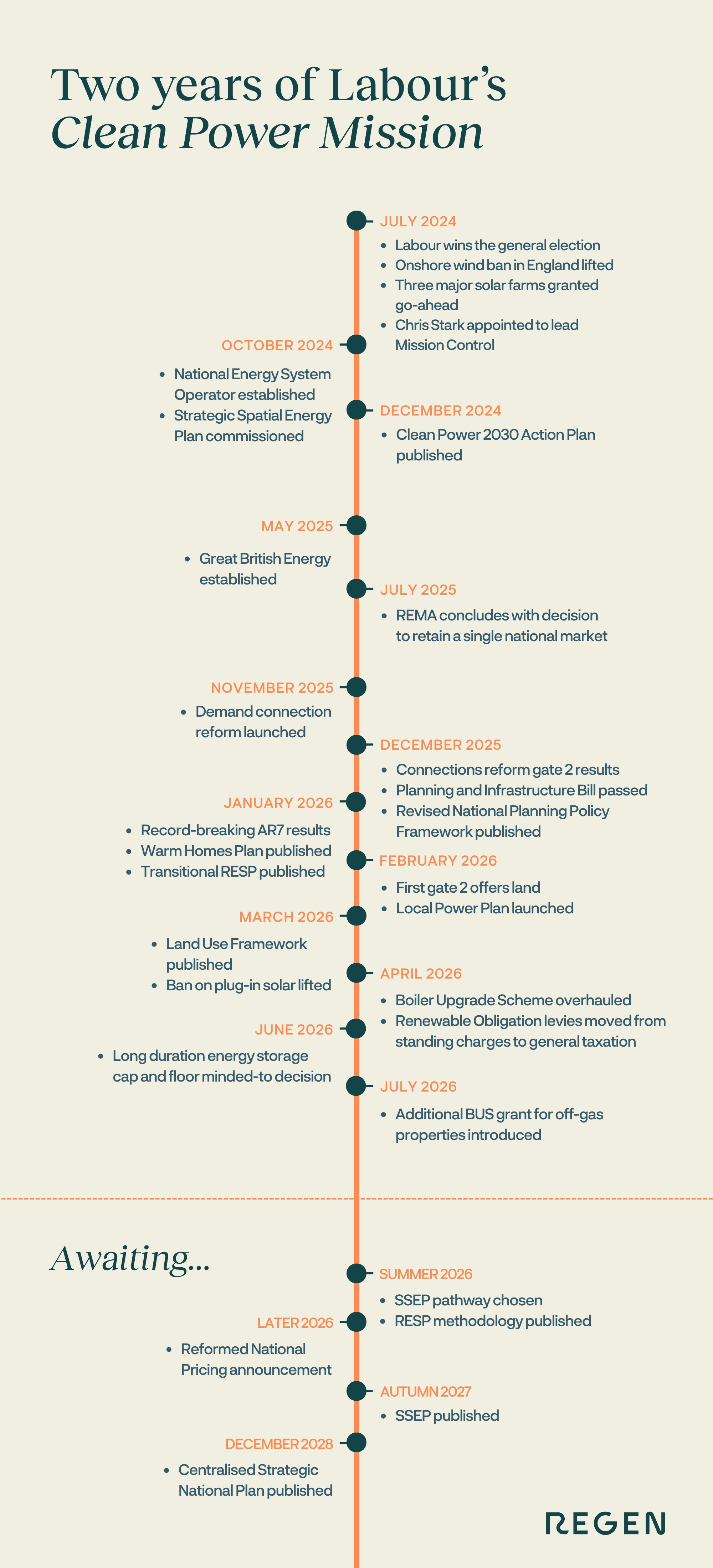
Our verdict at the end of that period was that Ed Miliband and his team had hit the ground running and generated some much-needed momentum with early moves such as lifting the ban on onshore wind and giving three large solar farms the go-ahead.
Appointing Chris Stark to head up Mission Control, upping the budget for AR6 and reforming AR7 all gave a confidence boost to industry. Meanwhile, announcing the creation of GB Energy signalled a commitment to ensuring that the transition should benefit everybody.
Two years in, the scale of challenge of delivering reform is abundantly clear and ministers are messaging that CfD allocation round 8 will be focused on price and value, rather than CP30. However, the mission continues to provide clarity and focus for government and industry.
The next Prime Minister will inherit a lot of reforms in motion, with questions remaining around the speed of grid upgrades, resolving the connections queue and the complex interplay of various spatial plans, not to mention electricity market design.
However, the challenge for the incoming PM is not simply maintaining momentum, it’s moving to the next phase of the mission: showing what clean power can deliver for people, places and the wider economy.
So how much progress have Labour made and what should be the new Prime Minister’s priorities?
An ambitious, and much needed, upgrade of transmission network is underway. Delivering this scale of reinforcement will be a major challenge for the networks as well as the governance from DESNZ, Ofgem and NESO – with any slippage directly affecting clean power and constraint costs.
The government, Ofgem and NESO have also driven forward reform of the connections queue, shifting away from a first-come, first-served model towards one that prioritises projects that are ready and ‘needed’. The process is now at a key point, with offers landing with developers.
The priority now for NESO and the networks is to is to keep to the planned timetable, deliver high-quality offers and ensure costs are kept to a minimum. Regen has called for industry to be fully engaged in the governance process for reform.
The government made a major strategic choice on market design by deciding to retain a national wholesale electricity market rather than move to zonal pricing. That decision removes one source of uncertainty for investors, but the underlying problems that drove the debate – constraints, balancing costs, the cost of managing congestion and inefficient dispatch – remain live issues.
The market reform agenda now needs to focus on practical fixes that can deliver consumer value without destabilising investment. The next phase should be guided by a simple test: does it help build, operate and pay for a clean power system in a way that lowers costs for consumers over time? If not, it risks adding uncertainty and complexity without solving the underlying problems.
As Regen’s GB Grid PriceXCarbon tracker shows, cleaner electricity is already linked with lower prices. However, planned interventions to ‘break the link’ between electricity and gas prices need to be carefully designed to deliver a good deal for consumers.
Lifting the effective ban on onshore wind in England on day one, bringing forward the Planning and Infrastructure Bill to speed up the planning system and signalling stronger support for renewables through the updated draft National Planning Policy Framework (NPPF) have all demonstrated a determination to remove barriers to clean energy deployment.
Planning reform now needs to be backed by stronger local plans and supportive regional plans. As councils begin updating their plans under a revised NPPF – expected this summer – they will need clear national policy direction and robust evidence on renewable energy opportunities. Removing national-level barriers was an essential first step; the next PM must ensure the planning system has the capacity and capability to deliver clean power at the pace required.
Resourcing of the planning system remains a key challenge. Training for planners and planning committee members is a very welcome step, but more action must be taken to address underlying resourcing challenges. We suggest introducing specialist renewable energy planners who can work across local authorities, ensuring projects are assessed efficiently and consistently.
With over half of Great Britain's current wind fleet expected to reach end-of-life decisions by 2035, repowering existing sites could unlock several gigawatts of additional clean capacity over the coming decades. However, that will only happen if planning, market and grid policies work together to create the right investment conditions.
This has been one of the most significant – if less visible – developments of the past two years. Through the Strategic Spatial Energy Plan, Regional Energy Strategic Plans and the reintroduction of Spatial Development Strategies, the government is beginning to create a framework for deciding what energy infrastructure should be built, where it should be located and how different parts of the system fit together.
The Energy Secretary is expected to choose a preferred pathway for the SSEP this summer, with a public consultation due in early 2027. Investors are eagerly awaiting the SSEP; any delay will heighten the risk of them looking to other countries.
Success will depend on the SSEP guiding investment and planning decisions in practice, which means market reforms, grid connections and the planning system aligning with it so that strategic decisions translate into faster, more coordinated delivery on the ground. It also depends on public confidence, so it’s vital that the consultation gives communities and industry genuine opportunities to influence decisions and benefit from implementation.
The Local Power Plan sets out a vision for an energy system that places more power into people’s hands, recognising the potential of local and community ownership to build public support, retain value, create local jobs, support energy advice and ensure that people experience the transition as something done with them rather than to them.
Alongside this, the establishment of Great British Energy and the commitment of up to £1bn for local power represents the largest proposed investment in community energy in UK history.
But ambition has not yet translated into delivery at the scale required. Investment needs to get out of the door and into communities.
The community energy sector also needs more than grant funding and pilot projects; it needs long-term certainty. The government should move forward with consultations on mandating community benefits and shared ownership for new renewable energy projects, giving more communities the opportunity to benefit directly from development in their area.
There are also regulatory barriers to address. Community projects still cannot easily sell electricity locally in a way that lowers bills for nearby households or businesses.
If the clean power mission is to retain public support, people need to see its benefits in the form of warmer homes, lower bills and greater energy security. The Warm Homes Plan, launched this year, recognises that decarbonising heat is central to delivering all of these. But while the policy direction is encouraging, implementation has been slow. The latest data shows heat pump installations have stalled.
With two crises in quick succession, the cost of energy is now front and centre for consumers. Closing the 'spark gap' and ensuring electricity pricing better reflects the benefits of clean power should therefore be one of the government’s highest priorities.
Delivery needs a much stronger local focus. Rolling out heat pumps and other low-carbon technologies at scale will require trusted local delivery partners, skilled installers and resilient supply chains, supported by local authorities that are empowered to coordinate action.
Protecting vulnerable consumers through targeted bill support and social tariff mechanisms will be essential to ensuring that lower-income households are not left behind.
Scotland and Ireland have both taken steps to embed just transition through dedicated strategies and commissions. The UK government should consider a similar approach, with a Just Transition Strategy and an independent body to advise, scrutinise and help ensure that the transition is fair across regions, sectors and communities.
A key shift over the past two years has been the move from clean energy as an environmental policy to a pillar of industrial strategy. Great British Energy, the National Wealth Fund, the Clean Industry Bonus, support for offshore wind supply chains, investment in ports, hydrogen and carbon capture all point towards a more active role for the state.
Rather than just trying to create the market conditions for private investment, government is looking to co-invest, shape supply chains, support strategic industries and direct clean energy investment towards places that need economic renewal. A deepening of this approach could help the UK capture more of the economic value of the transition, supporting jobs in industrial heartlands, ports and former fossil fuel communities and aligning clean power delivery with a broader reindustrialisation agenda.
Local government reorganisation and the creation of strategic authorities in England could provide the structures needed to devolve powers and funding for net zero more consistently. Done well, this could help align clean power, heat, transport, skills, planning and economic development at the right spatial scale.
The clean power mission has changed the direction and pace of UK energy policy. In two years, the government has set out a plan, created new institutions, restored momentum to investment, begun reforming grid connections, advanced planning reform and put public investment back at the heart of clean energy delivery.
Significant progress – but a long way to go. The next prime minister’s task will be to move to the next stage of the mission. The hard reforms already under way must be finished, grid and connections reform must deliver real-world results, and market reform must lower costs and support flexibility without destabilising investment. Planning reform must be backed by local capability and public trust. Industrial strategy must turn clean energy deployment into jobs, skills and supply chains. And the benefits of clean power must be felt by households, businesses and communities across the country.



