Through Innovate UK's Net Zero Living Programme, places seeking a sustainable future have been looking to retrofit their building stock to create better, warmer homes to both improve lives and local economies. Regen provides the programme with expert support on policy and regulation and on Wednesday 10 December we will be sharing some of the inspiring insights and best practice to help other local authorities understand how they can forge similar paths. You can sign up here.
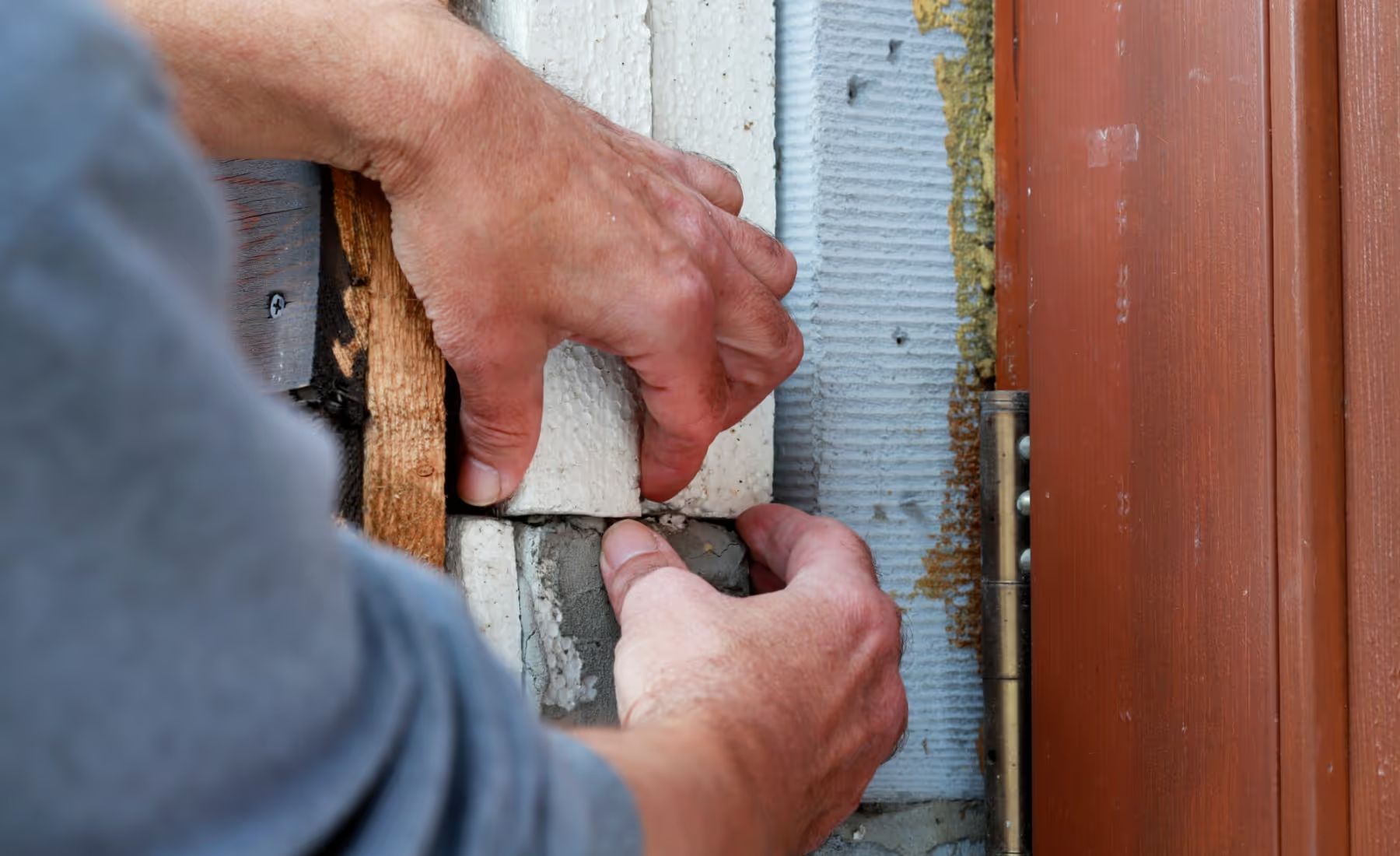
Cross-section of insulating layers in an old-style residential house.
A uniquely place-based endeavour
The Net Zero Living Programme has seen innovative activity from across the consumer journey, from understanding the wider value of retrofit, to working with supply chains and finance and one stop shops providing place-based services.
Crucial to this retrofit journey is being clear on what investment is needed by understanding the specific retrofit needs of individual buildings, such as those in conservation areas.
Throughout 2025, we’ve watched the government set out a suite of proposed policy reforms in the housing sector as it prepares to deliver against its commitment to improve the energy efficiency of five million homes.
As we edge ever closer to the long-expected launch of the Warm Homes Plan (now expected in early 2026), we are eagerly awaiting how the government will support the improvement of 12.7 million homes that currently have an EPC rating lower than C (2021 Census data).
Retrofitting homes is a uniquely place-based endeavour. Local authorities are at the front line of delivering progress and need future-ready standards to meet the bold targets for improving our buildings set at both national and local levels. Through the Net Zero Living Programme, Regen, with the National Retrofit Hub, has been helping the local areas in a retrofit policy group to understand and respond to these proposed policy changes, which should help to accelerate local net zero, tackle fuel poverty and reduce housing-related public health crises.
Laying the groundwork
Throughout 2025, we’ve watched the government set out a suite of proposed reforms in the housing sector. First was the improved and expanded metrics for energy performance certificates (EPC), to improve the information about building performance. Then came the proposed increase of minimum energy efficiency standards to C (from E), designed to increase minimum acceptable standards.
The Net Zero Living Programme policy group sees these proposals as a step change in housing standards. With increases in resources and innovative new approaches for delivery, they can be a trigger that accelerates and scales retrofit across places.
Harnessing local power
Local authorities and their housing teams have a significant stake in these reforms, as they are the organisations responsible for enforcing standards in the private rental sector.
The biggest impact on the social rented sector is tying the Decent Homes Standard with Minimum Energy Efficiency Standards. If the minimum criteria do end up being EPC C, that is massive for any organisation looking after property. – Net Zero Living Programme retrofit policy group member
When you add in the social housing stock owned by local authorities, this suite of proposals will be stretching the powers and assets of local authorities to achieve better homes.
Local authorities are crucial for delivering retrofit at scale.
This is the first time that energy efficiency has been prioritised from a top-down push which is great. It does however come with challenges, so overall we’re excited and supportive but cautious about how to deliver this. – Net Zero Living Programme retrofit policy group member
The Net Zero Living Programme has been piloting innovative place-based solutions for growing local retrofit markets and these policy reforms, which drive accelerated retrofit activity, should encourage these solutions to be more widely adopted.
Identifying retrofit value
Having improved varied metrics to measure the performance of a house will give local authorities and retrofit professionals more and better tools to work with.
As part of the Net Zero Living Programme, Cardiff Council, for example, has partnered with Bankers without Boundaries to produce a co-benefits study aimed at demonstrating the wider value of retrofit, acknowledging that traditional return on investment doesn’t fully convey the true impact of retrofit.
For example, it’s estimated that illness related to damp and poor housing costs the NHS £1.4 billion a year, a stat which is not factored into traditional return on investment models.
Local authorities in the retrofit policy group felt that the broader metrics (including fabric efficiency) in the reformed EPCs could help to create stronger links between housing performance and health impacts – potentially creating new business cases based on reduced healthcare burden.
The group acknowledged that health benefits are an important investment consideration for local authorities and individual consumers.
We’ve engaged with an individual with chronic arthritis, and she had heard that heat recovery systems can help with her situation and had been exploring this, despite low uptake in the UK.
– Net Zero Living Programme local authority participant
Steps to improve the accuracy and quality of EPCs in the reform were also welcomed, with low consumer trust and confidence in the retrofit sector identified as a key barrier to growing markets.
The policy group also felt that some of the EPC reforms could go further. Creating clearer pathways for appropriate retrofit measures, along with more compelling information on their potential impact, would significantly improve the overall influence of EPCs on the retrofit journey.
But as Net Zero Living Programme partners design innovative, place-based solutions to enable greater demand and supply in local retrofit markets, it is clear that better standards, trust and recommendations in EPCs will be a powerful tool for local authorities to accelerate retrofit uptake in their places.
Taking Net Zero Living learnings beyond the programme
Net Zero Living Programme has gathered a vast range of insights, learnings and demonstrable solutions for local retrofit.
Through the work of the Retrofit Policy Group in partnership with the National Retrofit Hub, local authorities have demonstrated exceptional expertise and innovation in leading their projects and designing the scalable, replicable solutions needed to accelerate retrofit activity nationwide.
Launching 10 December 2025 at an online event, the Better, Warmer Homes insights paper will bring these learnings together into an insight for local authorities, policy makers and key stakeholders in the retrofit space, demonstrating four key learnings:
Bold and innovative approaches to modelling benefits can help create more compelling business cases for retrofit
Improved standards are welcome but require innovative and bespoke local solutions to deliver desired outcomes
Local authorities have a central role in delivering the confidence and scale required in local supply chains
Consumers need accessible and affordable access to retrofit markets and local authorities can play an important convening role in the development of the market infrastructure that achieves this.
These learnings can be used to inspire the design of local retrofit solutions, inform policy making at the national and local level, and support wider thinking about how the UK empowers local retrofit markets to grow at pace.
Watch back
On Wednesday 10 December we held a webinar to share some of the inspiring insights, best practice and expertise generated by the Net Zero Living Programme, with the aim of helping other local authorities understand how they can forge similar paths. You can watch that webinar below.
Join us on 13 January to learn about approaches to community empowerment and on 12 February for learnings around planning, pipeline and finance. You can sign up to both here.