Floating offshore wind is on the cusp of commercial-scale deployment. As the first larger-scale sites progress towards delivery, the first Strategic Spatial Energy Plan will be a critical test of the UK’s long-term commitment to the technology. Our new paper, commissioned by Scottish Renewables, sets out how the SSEP can provide the confidence needed to maintain investment momentum, support the deployment and learning needed to reduce costs, and help turn the UK’s early leadership into a globally competitive industry.
The next five years will be critical for UK floating offshore wind (FLOW). As the first commercial-scale projects are delivered in Scotland and the Celtic Sea, maintaining deployment momentum will be essential to reducing costs, strengthening UK supply chains and establishing the industrial capability required to compete in a globally competitive industry.
Regen was commissioned by Scottish Renewables to examine the role of the first Strategic Spatial Energy Plan (SSEP) in maintaining this momentum and supporting the UK’s emerging FLOW industry.
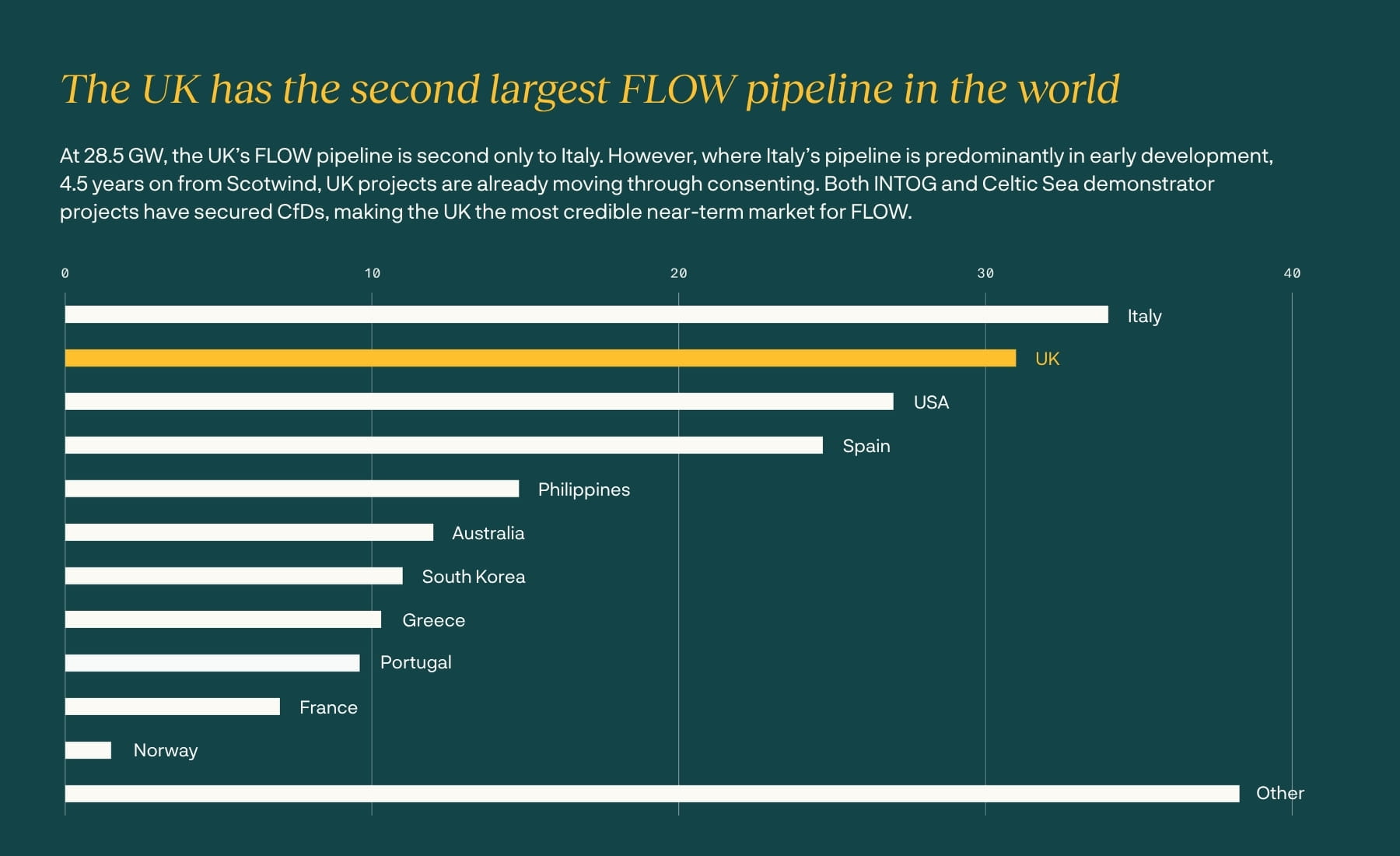
The UK has established an early leadership position in FLOW, with the third-highest operational capacity worldwide and around 14% of the global portfolio. This has been built on decades of offshore expertise, deep-water capability from the North Sea energy sector and experience delivering fixed-bottom offshore wind. Scotland has led early deployment, hosting some of the world’s first FLOW projects, while the emerging Celtic Sea programme will extend this opportunity across the UK.
That leadership is already being backed by significant public and private investment. Through ScotWind’s Supply Chain Development Statements, developers have committed £25.5bn to fixed and floating wind. Allocation Rounds 7’s Clean Industry Bonus has leveraged around £3.4bn of private investment into British manufacturing, factories and ports, supporting 7,000 jobs, while Great British Energy, the National Wealth Fund and other key public bodies have committed up to £1bn to strengthen UK offshore wind supply chains.
The priority now is to maintain this momentum. Investors, developers and the wider supply chain need confidence that these existing commitments will be matched by a clear long-term deployment pathway, enabling projects to progress and attracting further investment. The industry recognises the need to demonstrate a clear cost-reduction pathway, but this depends on projects being built, generating operational learning and enabling supply chains to scale. Maintaining momentum on early projects will therefore be critical to delivering the cost reductions needed for wider commercial deployment.
Why the first SSEP will be key
The first SSEP will set out where future generation technologies should be located and the scale of deployment required to deliver a secure, affordable and net-zero electricity system by 2050. As such, it will be a vital signal to investors, developers and supply chains about the technologies required to deliver the UK’s future energy system, providing strategic direction for future deployment, infrastructure planning and investment decisions.
For FLOW, the SSEP represents one of the clearest signals about the UK’s long-term commitment to commercial deployment. With much of the committed deployment expected over the next five years and delivery dependent on projects meeting milestones, the SSEP will reinforce confidence in the UK’s longer-term commitment to FLOW, reducing investment risk and ensuring decisions on leasing, networks, planning, revenue support, and supply chains align behind this ambition. This certainty will support the sustained deployment needed to drive cost reductions as projects mature and scale.
The SSEP should therefore not only identify where FLOW can contribute to the future energy system, but also recognise the technology's wider strategic value.
This includes:
A more resilient energy system: FLOW can unlock deeper waters with strong and geographically diverse wind resources. This complements existing generation and contributes to a more secure, resilient and lower-cost electricity system.
Regional economic growth: Commercial-scale deployment can anchor new industrial activity across the UK, supporting investment in ports, manufacturing, engineering, marine services and coastal communities.
A deliverable pathway to commercialisation: FLOW builds on the UK’s North Sea energy heritage, including offshore engineering, subsea systems and marine operations, providing a pathway for the transition of skills, businesses and infrastructure into the next phase of offshore energy development.
Our recommendations for the SSEP
To maintain confidence and unlock investment, the SSEP should provide:
A clear deployment pathway: the scale, regional distribution and timeline of FLOW deployment aligned with the UK’s ambition to establish the technology at scale
Recognition of system value as well as LCOE: FLOW can reach deeper waters off the coast of Scotland and the Celtic Sea, providing improved energy resilience and reduced balancing costs
A clear commitment beyond spatial planning: commentary accompanying the SSEP should recognise the FLOW opportunity and reinforce support through technology development, supply chains and infrastructure
Alignment with wider market signals: the SSEP should be reinforced by future leasing, network investment, planning reform and revenue support mechanisms
An SSEP that pushes FLOW deployment beyond the investment horizon would send a negative signal at a critical stage of market development, risking projects progressing from consent towards final investment decision and construction. Cost reductions will come through building projects, gaining operational experience and scaling supply chains, not by waiting for deployment.
Without a clear UK pathway, there is a risk that FLOW technology, expertise and supply-chain capability will move to markets that provide stronger signals and clearer routes to commercialisation. This would weaken the UK’s ability to capture the industrial and export opportunities associated with a growing global market that the UK has helped pioneer.



.jpg)


%20(1).jpg)
.jpg)