Johnny Gowdy examines plans to extend the Electricity Generator Levy and introduce a new Wholesale Contract for Difference for legacy generation assets, asking whether these measures are likely to reduce bills or provide meaningful protection for consumers in the near term.
Regen has partnered with DESNZ, Great British Energy and the Local Net Zero Hubs to create training and guides to support confident, consistent and timely decisions on applications for low-carbon energy generation, storage and network infrastructure.
In this first paper in a new insight series, we unpack what transmission constraints are, why they've increased and what's really driving the costs.
With more than half of GB’s current onshore wind fleet expected to face end-of-life decisions by 2035, repowering is a critical but overlooked consideration that will shape the UK’s future energy security. This paper highlights the barriers holding back onshore wind repowering and sets out urgent actions to unlock the potential of the existing fleet.
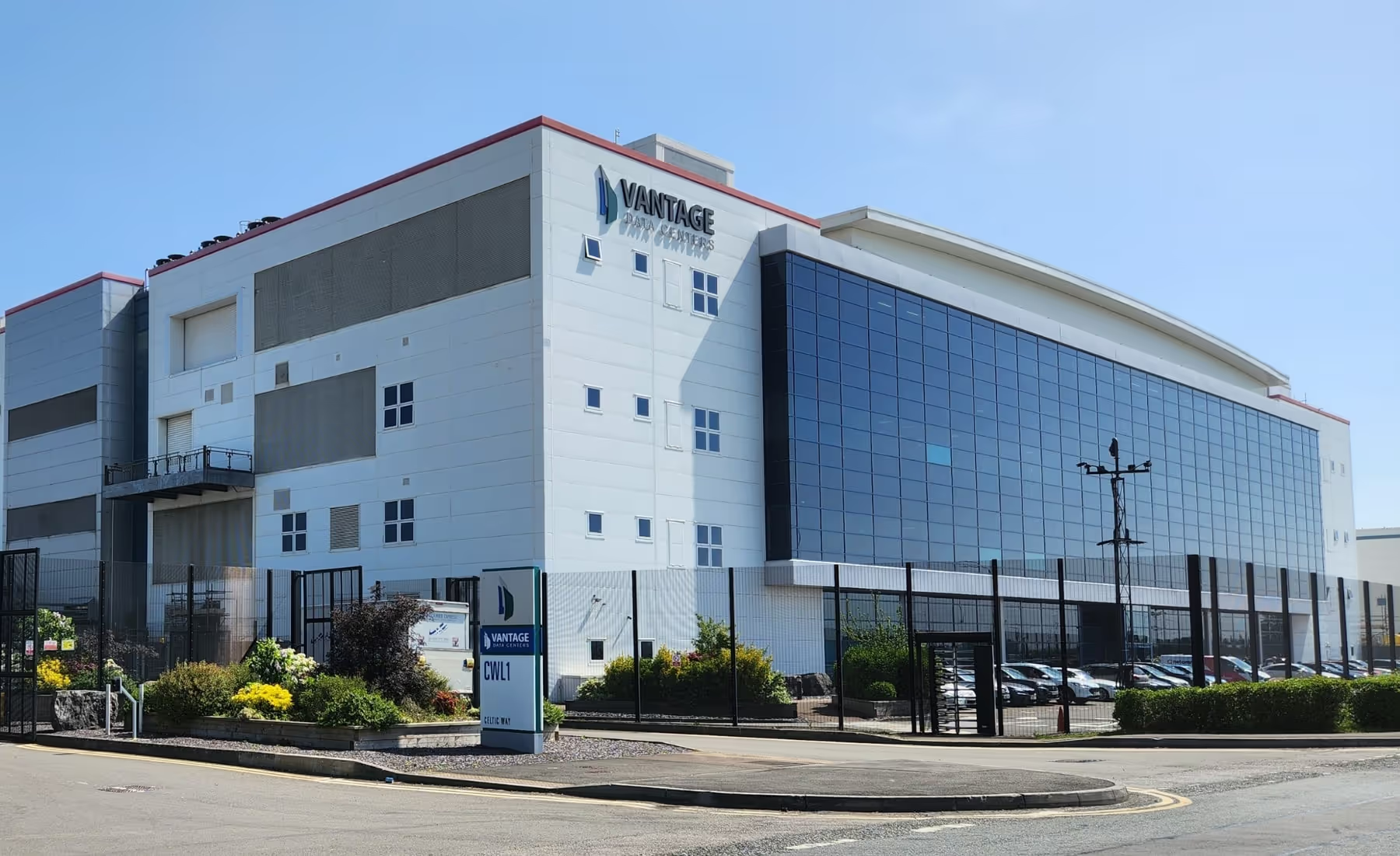
As part of the 2025 DFES update, we conducted an analysis of the growth and impact of data centres in National Grid Electricity Distribution’s licence areas. This paper summarises the potential future uptake of data centres, the geographical factors driving AI growth in particular areas, and commentary on the wider network and societal impacts of data centre development in the UK.
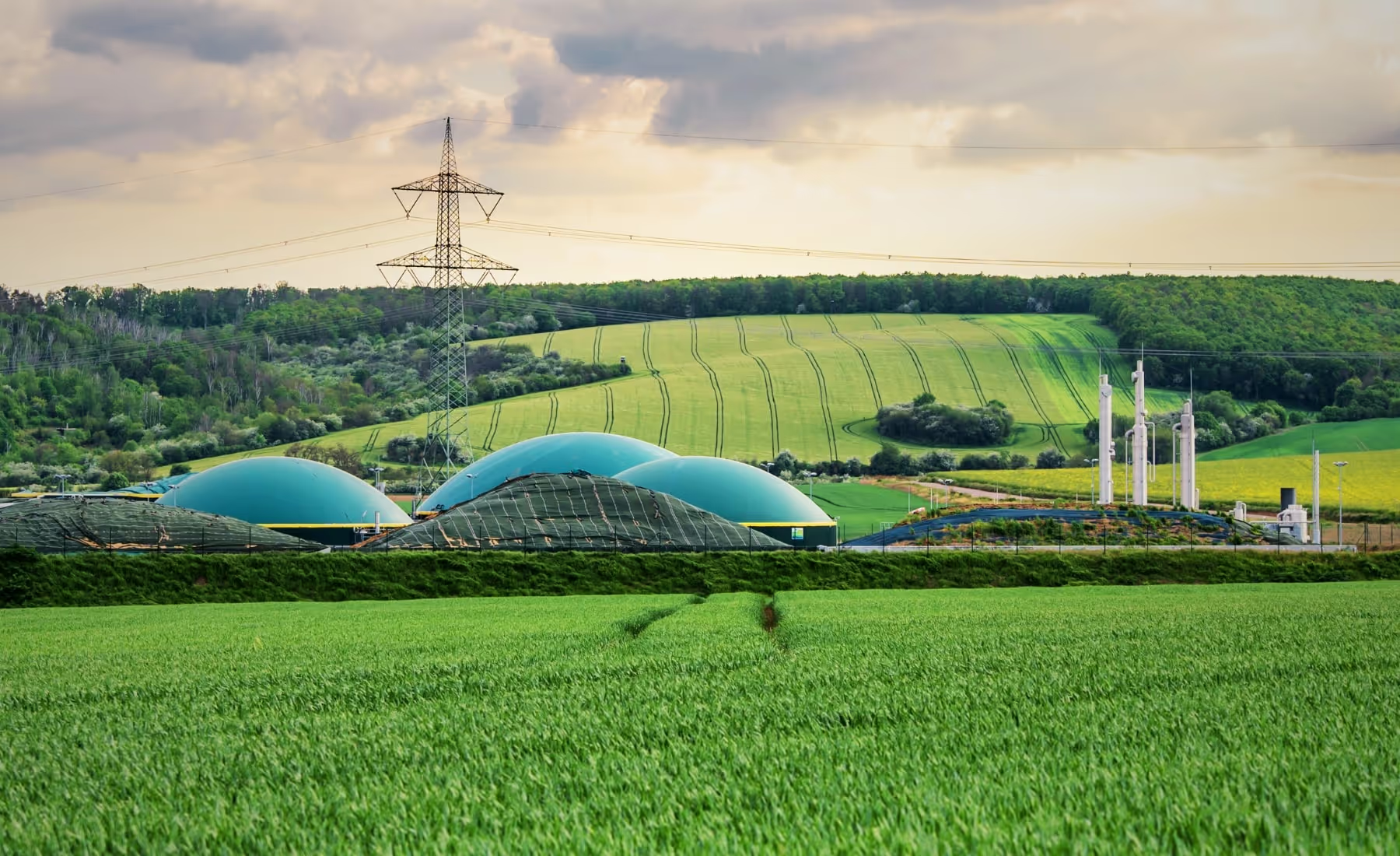
Our latest paper considers recent biomethane supply projections and assesses the likely feasibility of this ‘green gas’ replacing fossil fuels for consumer use.
With planning a critical enabler of net zero, our latest briefing explores the scale of the challenge and some of the practical solutions already being explored by local planning authorities.
With zonal pricing now ruled out, Johnny Gowdy considers the challenges and opportunities still facing the government to deliver investment and meaningful benefits for consumers before the next election.
This guide is for people developing community energy projects who want to get a connection to the electricity network. It provides an introduction to the electricity network and an overview of the application process for different types of new energy generation relevant to community energy groups.
Joel Venn, head analyst at Regen highlights the importance of granular-level modelling in creating a fairer and more decarbonised future.
Joel Venn
Regen has conducted an innovation project with Western Power Distribution (WPD) and Wales & West Utilities to develop an integrated approach to electricity and gas scenario planning, funded by the Network Innovation Allowance.
Poppy Maltby
Ray Arrell
Joe Noble, graduate intern at Regen, discusses the role of interseasonal storage in contributing to a net zero electricity system in the UK.
This month's graphic highlights the domestic fuel price distortion created by current environmental levies and highlights the opportunity to reconfigure these into a new domestic carbon levy.
Johnny Gowdy
A new paper published today by leading energy system experts Regen, identifies that heat energy, which now accounts for over a third of the UK’s carbon emissions, is the greatest decarbonisation challenge the UK faces to meet its net zero carbon commitment.
Madeleine Greenhalgh, policy and advocacy manager at Regen, has set out the key points in our response to the Ministry for Housing, Communities and Local Government (MHCLG)’s Future Homes Standard consultation.
Regen director, Johnny Gowdy, ponders the future role of natural gas in a decarbonised world.
This week Ofgem have released a working paper which contains their initial thoughts on the crucial decision about the distribution connection boundary. We are gathering input from our members on their experiences of how the current high costs of connecting to the network have affected investments in distributed renewables and storage.
Our ambitious paper, Energy Networks for the Future, highlights the need for a new partnership between the public and private sector to deliver the energy infrastructure needed to achieve net zero decarbonisation.
OpenDSR is a government-funded project looking to demonstrate a concept for domestic demand side response (DSR) and support the development of a business model for the Energy Community Aggregator Service (ECAS), a community-owned DSR aggregator and energy service provider.
Tamar Bourne
Regen's senior project manager, Poppy Maltby, explains Regen's response to the consultation on a Regulated Asset Base (RAB) Model for Nuclear.
Regen worked with the Energy Systems Catapult (ESC) to explore the potential benefits for community energy organisations of engaging with the Catapult's Local Area Energy Planning (LAEP) process, as well as the benefits that their engagement would bring to the process. The output was a report for the ESC to inform the development of the LAEP process going forwards.
Hazel Williams
Regen’s senior project manager, Tim Crook, explains how community energy organisations could play a bigger role in providing network flexibility.
Tim Crook
Regen’s smart energy expert, Tamar Bourne, takes a closer look at how new technology platforms, and new customer propositions, will enable consumers and business to buy clean and affordable energy users in the future.
Heat remains one of the most challenging areas of the UK energy system to decarbonise. A number of pathways are being explored, including deeper levels of energy efficiency, broad-scale electrification, low-carbon heat networks and the development of hydrogen as a new heating fuel.
An investigation is set to follow Friday's widespread power cut which will no doubt shed further light on what happened, why it happened, and the impact of the resulting shut down of sections of the high voltage network.
Hazel Williams, who leads Regen’s public sector advisory services and is an expert in issues relating to planning for sustainable energy, details a new report for the RTPI on the needs to change planning to support a smooth transition to a net zero-carbon future.
Regen is pleased to launch our latest paper, 'A bright future: opportunities for UK innovation in solar energy', at the House of Lords in collaboration with UK Energy Research Centre (UKERC) and EPSRC.
To support Wales & West Utilities' future gas demand forecasting, network analysis and investment planning, Regen has been commissioned to undertake a Network Innovation Allowance funded project. The scope of the project is to develop and trial a new methodology to create a set of regional and sub-regional growth scenarios for gas and heat from a 2018 baseline out to 2035.
Jonty Haynes
We are excited to publish our guide to local flexibility markets which outlines what they are and how community energy organisations can get involved. In this guide we explore the need for electricity system flexibility, review market development, highlight the case for open standards and outline the ECAS (Energy Community Aggregator Service) concept.
Regen have partnered with the Institute of Welsh Affairs (IWA), as part of the IWA's Re-energising Wales project, to set out a number of clear recommendations on how to protect, promote and achieve scale in community and local ownership of renewable energy in Wales.
This paper brings together an inspiring collection of articles, produced by leading women, on the key role diversity will play in the success of the smart and renewable energy sector in transforming our energy system.
Rachel Hayes
When Professor David Sergeant, a scholar of literature and environment at the University of Plymouth, first spoke with Regen in 2014, the question was simple but profound: what happens when we bring people together to imagine better futures — and feed them while we do it?
Chloe Uden
Feast for the Future was a creative and participatory project exploring the future of energy through the shared experience of communal meals. Across South Devon, five community-led ‘Utopian feasts’ invited people to reimagine a fairer, cleaner, and more connected energy system. The meals became a medium for storytelling, conversation, and imagination—highlighting the links between food, energy, sustainability, and community.
When artist and activist Loraine Leeson and a group of older men from East London – known fondly as The Geezers – first began exploring tidal power on the River Thames, none of them imagined that their small experiment would evolve into Active Energy, a twelve-year collaboration recognised with Regen’s Arts and Green Energy Award.
There has been a rapid growth in the number of low-cost green tariffs on offer for renewable electricity. This has been accompanied by a sharp rise in consumers switching away from the 'big 6' to take advantage of cheap energy deals, while also doing their bit for the planet. This is great news and an indication that the public, and many businesses, are strongly motivated to go green and support the growth of renewable energy technologies.
The Hayle Coastal Communities Team project was established by the Hayle Harbour Advisory Committee in 2015 and has been funded by a DCLG Coastal Community grant. The HCCT team is made up of individuals and stakeholders who have a direct interest to support the future sustainable development of Hayle Harbour.
The paper answers some of the big questions posed to our policy makers regarding the impact EVs will have on our infrastructure networks. It assesses the place of EVs in the UK transport system and strategies to manage the impacts on the UK’s energy network.
Olly Frankland
The IWA's Re-energising Wales project has brought together representatives from industry, regional stakeholders and academia that have an interest in the future development and transformation of the energy system in Wales. The overall objective of the project is to provide practical plan by which Wales could achieve its ambition to maximise its use of renewable energy resources by 2035, resulting in an 80% reduction in energy-related greenhouse gas (GHG) emissions.
When Naomi Wright joined Regen as its first Art and Energy intern, she found herself standing at the edge of something new: a collaboration that blurred boundaries between art, community, and the energy transition.
When Clare Bryden first picked up her knitting needles to make art, she didn’t think she was becoming an artist. Her background was in science and maths — numbers, systems, and logic.
The paper 'Energy Storage: The Next Wave' looks at the key role of energy storage in providing flexibility as the transformation to low carbon and more decentralised energy continues. The paper sets out the key challenges for government and market to overcome if energy storage is to achieve its potential to play a key role in the smarter energy system.
The third edition of this paper focuses on the most recent innovations and thinking in local supply models. It looks at where there are sources of value from a more local approach, which can then be reflected in lower tariffs for demand customers and a better price for local generation.
When Anna Speedy first heard that Totnes was going to create a brand-new musical about energy, community, and sustainability, she immediately knew she wanted her students to be part of it.
Exploring energy outdoors with emerging artists and communities
Given the punchy title you might think that Professor Dieter Helm, Oxford University's preeminent energy academic, has finally turned on the industry to which he is closely associated. Not so, Helm's narrative of a long-term decline, via a 'golden age for gas', is quite closely aligned with what oil and gas industry lobbyists are currently saying.
Regen worked with Western Power Distribution (WPD), Wadebridge Renewable Energy Network (WREN) and Tempus Energy to trial a Sunshine Tariff in Wadebridge, Cornwall.
The SWIMBY Songbook remains a resource for choirs and communities to perform, ensuring the project’s messages live on. It also paved the way for Regen’s continued interest in musical, performative, and participatory approaches to energy engagement.Matt reflects:“Energy projects can inspire music, laughter, and togetherness. SWIMBY was proof that climate action doesn’t have to be grim — it can be joyful.”
The Element in the Room showed that art can be more than an add-on to climate communication — it can be a catalyst for connection. By blending humour, lyricism, and celebration, Matt’s poetry helped make energy a subject people could relate to, enjoy, and even sing about. “Poetry gave people another way in — through fun, reflection, and imagination. That felt valuable.”
Celebrating the role of creativity in shaping our energy future
Energy storage is poised to grow rapidly in the UK towards 10 GW in the 2030s - but action is needed to align the technology with market and policy signals if this potential is to be realised. This paper was Regen's first publication around energy storage, released in November 2016. It summarised the state of the energy sector and proposed a set of 5/6 business models for storage.
Regen had the privilege of collaborating with artist and producer Richard Povall, Director of Art.Earth Books, on Feeding the Insatiable — an international gathering at Dartington exploring the real and imagined narratives of art, energy, and the environment for a “troubled planet.
The UK electricity system is rapidly changing. Following a radical increase in the amount of renewable generation, we are now seeing the growth of smart technology and services that can enable more flexibility in the way we generate, supply and use power. The National Infrastructure Commission has responded to these changes by calling on the UK to lead the world in a 'smart power revolution'.
Merlin Hyman OBE
A creative summit at the nexus of art, energy, and ecological imagination
In March 2016, Regen partnered with Arts University Plymouth to explore how creativity can help people connect with sustainability and energy themes. The collaboration took the form of a live brief for Foundation level students: design a poster that communicates an idea about energy, climate, or sustainability.
In March 2013 Ofgem published its 'Strategy decision for the RIIO-ED1 electricity distribution price control'. This proposed that to reduce the cost of grid reinforcement to individual developers and first movers, developers apply for grid reinforcement as a consortium, teaming up with other developers operating in the same region.





.jpg)
.jpg)
%20(1).jpg)
.jpg)