Working with London Councils and Repowering London, Regen has created guidance to help time-constrained local authority officers enable community energy in their borough to flourish.
With more than half of GB’s current onshore wind fleet expected to face end-of-life decisions by 2035, repowering is a critical but overlooked consideration that will shape the UK’s future energy security. This paper highlights the barriers holding back onshore wind repowering and sets out urgent actions to unlock the potential of the existing fleet.
As part of the 2025 DFES update, we conducted an analysis of the growth and impact of data centres in National Grid Electricity Distribution’s licence areas. This paper summarises the potential future uptake of data centres, the geographical factors driving AI growth in particular areas, and commentary on the wider network and societal impacts of data centre development in the UK.
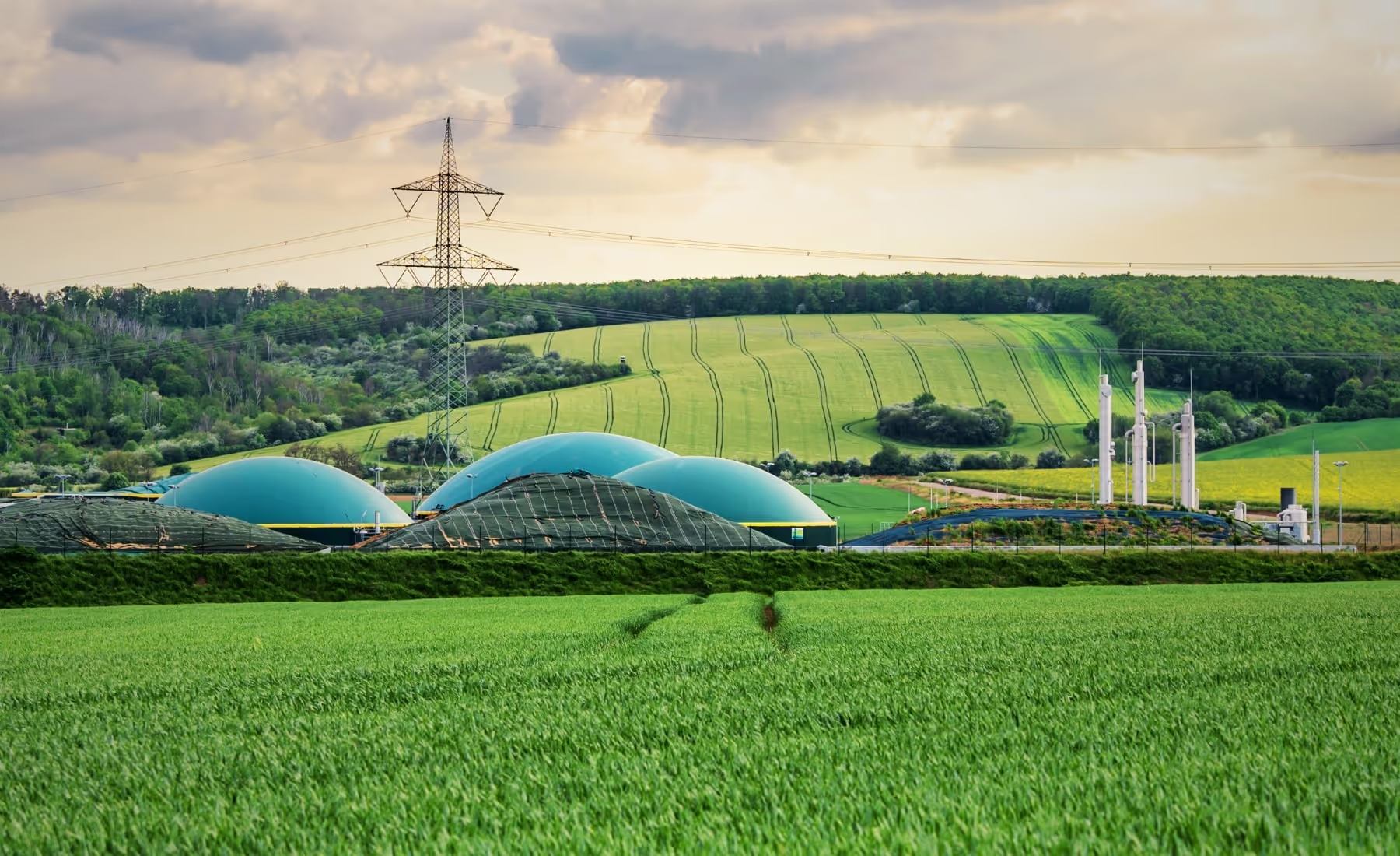
Our latest paper considers recent biomethane supply projections and assesses the likely feasibility of this ‘green gas’ replacing fossil fuels for consumer use.
Ray Arrell reflects on the process pioneered by Regen back in 2015 – and how it has developed into a detailed, bottom-up approach to regional network planning.
With planning a critical enabler of net zero, our latest briefing explores the scale of the challenge and some of the practical solutions already being explored by local planning authorities.
With zonal pricing now ruled out, Johnny Gowdy considers the challenges and opportunities still facing the government to deliver investment and meaningful benefits for consumers before the next election.
Accompanying the UK Hydrogen Strategy in July was a plethora of consultations and calls for evidence. Regen has responded to the consultations on the design of a low-carbon hydrogen standard and a hydrogen business model.
Grace Millman
Next week, in the run-up to COP26, we are expecting the government to publish the UK's Net Zero Strategy, including long-awaited plans to start to wean us off gas boilers to heat our homes.
Merlin Hyman OBE
The energy crisis of September 2021 has been a stark reminder of the vulnerability of the UK energy system because of its continued dependency on fossil fuels.
Johnny Gowdy
In response to very high gas prices, Madeleine Greenhalgh, policy lead for the Electricity Storage Network, states the importance of investing in energy storage.
The Heat and Buildings Strategy is one of the most important pieces of policy currently being relentlessly ruminated in the government machine. It's the most vital missing part of the net zero puzzle and we need to start implementing a clear plan for decarbonising heat as soon as possible.
Regen has produced a unique study with the Dorset Local Enterprise Partnership (LEP) to identify the low carbon investments opportunities within Dorset, as well as to understand the economic benefits that could reach the local area from the shift to decarbonised energy for heat, transport and power.
Poppy Maltby
Tamsyn Lonsdale-Smith
Hazel Williams
Mark Howard, Regen's project manager and Sustainability Task Force lead, sets out our action plan for reducing Regen's business emissions to net zero by 2035.
Regen has been working with the Department for Business, Energy and Industrial Strategy (BEIS), Ofgem and Innovate UK to illustrate how energy system digitalisation could improve the future consumer journey as part of the UK's first Energy Digitalisation Strategy, which was published last month.
Tamar Bourne
As we await the delayed publication of the UK government's Hydrogen Strategy, and the even more delayed Heat and Buildings Strategy, Regen has been giving some thought to the question of whether hydrogen could become a widespread heating fuel, in the manner of natural gas.
Bruce Bardsley, energy analyst intern at Regen, takes a look at the data released from National Grid ESO which describes actions taken in the balancing mechanism.
Bruce Bardsley
Grace Millman reflects on Regen's work with Cornwall Council and the Cornwall and Isles of Scilly LEP to identify the potential opportunities for hydrogen to support decarbonisation in the region by 2030.
Ray Arrell
Next in our Race To Zero series: Mark Howard, Regen's project manager and Sustainability Task Force lead, provides an update on our efforts to measure and report our greenhouse gas emissions.
The government has published the long-awaited Transport Decarbonisation Plan setting out a programme of actions to reduce emissions across the transport sector in line with the net zero by 2050 target.
Olly Frankland
Poppy Maltby, head of cities and regions at Regen, unpacks Ofgem's minded-to decision on changes to accessing the electricity network.
Mark Howard, project manager at Regen, draws on his experience as an engineer installing and servicing low carbon heating technologies, to discuss why decarbonising heat is as much a people problem as it is an infrastructure problem, and proposes a package of solutions to build this approach into future policy.
Ray Arrell, Regen's Head of Technical Development and member of our internal Net Zero Task Force, summarises our work on looking to tackle our carbon emissions from office energy use.
Regen is working with Devon County Council to set up a Devon renewable electricity tariff that supports local, preferably community owned, generation.
Heat Creatures was a Regen Art Lab residency, launched in autumn 2021 to explore how creative practice could open up difficult, technical conversations—starting with the decarbonisation of home heating.
Chloe Uden
In this blog, Grace Millman considers the potential application of hydrogen to decarbonise the industrial sector, exploring the steel and cement industries in particular.
In an open letter to the energy minister signed by a group of our members, we set out six policies for the government to implement to decarbonise heat and buildings, secure future-proof green jobs and support small businesses.
The vision of the ReWiRE network is to make gender diversity a priority at all levels of the clean energy sector, making companies more resilient and able to innovate. The ReWiRE mentoring programme supports women in the clean energy industry to progress their careers.
Rachel Hayes
Joel Venn, head analyst at Regen, has undertaken analysis which visualises some of the changes in energy required to meet the UK's new climate target.
Joel Venn
Mark Howard, Regen's lead on the internal Sustainability Task Force, outlines Regen's net zero commitment, our journey to making it, and how others can join the Race To Zero.
From July to December 2020 Regen worked with Scottish and Southern Electricity Networks (SSEN) to produce energy efficiency demand reduction factors for both the North of Scotland and Central Southern England licence areas. This analysis used scenarios to look at the impact of domestic, commercial and industrial energy efficiency measures on electricity demand, down to primary substation level.
Jonty Haynes
Moving electricity from where it is generated to where it is used is fundamental to our energy system. After decades of incremental change, the UK's electricity infrastructure and systems now need to develop rapidly to support further decentralised generation as well as the increased electrification of transport and heat.
Inspired by the recent budget announcements and the current economic and public health crisis, I'd like to look at the costs to the public of inefficient housing, which the government continues to show wavering commitment to rectifying (Green Homes Grant, I'm looking at you), through the lens of healthcare. While there are many relevant and undervalued benefits to society from improving low energy efficiency homes, including but not limited to financial and carbon emissions savings, I believe there is a case for change on healthcare grounds alone.
Sophie Whinney
Our latest paper with Kensa heat pumps shows how shared ground arrays could unlock a larger market for ground source heat pumps, whilst reducing peak winter electricity demand.
Tim Crook
The Crown Estate has now announced the results of the Round 4 leasing round and the winning developers who will take forward six new offshore wind farms (totalling almost 8 GW of capacity) in the waters around England and Wales.
Poppy Maltby, head of cities and regions at Regen, discusses the options for local authorities to procure local renewable electricity based on a feasibility assessment of the ‘Sleeving Pool’ approach for Bristol City Council.
This insight paper investigates the hydrogen value chain, from production to end-user, and assesses how this complex and multifaceted energy solution can best be supported by targeted policy interventions.
Johnny Gowdy, Regen's director, reacts to the Scottish Government's Update to the Climate Change Plan.
Regen was one of the partners on OpenLV, a network innovation trial with Western Power Distribution (WPD) which gave communities and businesses access to local electricity substation data.
Ofgem has today confirmed that they will define electricity storage as a subset of generation and amend the generation license accordingly.
Our policy and advocacy manager, Madeleine Greenhalgh, explores how carbon is measured and valued in flexibility markets.
Tamar Bourne, senior project manager at Regen, explores the potential for energy data to help us meet the net zero challenge in our local areas.
This guide is for people developing community energy projects who want to get a connection to the electricity network. It provides an introduction to the electricity network and an overview of the application process for different types of new energy generation relevant to community energy groups.
Joel Venn, head analyst at Regen highlights the importance of granular-level modelling in creating a fairer and more decarbonised future.
Regen has conducted an innovation project with Western Power Distribution (WPD) and Wales & West Utilities to develop an integrated approach to electricity and gas scenario planning, funded by the Network Innovation Allowance.
Joe Noble, graduate intern at Regen, discusses the role of interseasonal storage in contributing to a net zero electricity system in the UK.
This month's graphic highlights the domestic fuel price distortion created by current environmental levies and highlights the opportunity to reconfigure these into a new domestic carbon levy.
A new paper published today by leading energy system experts Regen, identifies that heat energy, which now accounts for over a third of the UK’s carbon emissions, is the greatest decarbonisation challenge the UK faces to meet its net zero carbon commitment.
Madeleine Greenhalgh, policy and advocacy manager at Regen, has set out the key points in our response to the Ministry for Housing, Communities and Local Government (MHCLG)’s Future Homes Standard consultation.
Regen director, Johnny Gowdy, ponders the future role of natural gas in a decarbonised world.
This week Ofgem have released a working paper which contains their initial thoughts on the crucial decision about the distribution connection boundary. We are gathering input from our members on their experiences of how the current high costs of connecting to the network have affected investments in distributed renewables and storage.
Our ambitious paper, Energy Networks for the Future, highlights the need for a new partnership between the public and private sector to deliver the energy infrastructure needed to achieve net zero decarbonisation.
OpenDSR is a government-funded project looking to demonstrate a concept for domestic demand side response (DSR) and support the development of a business model for the Energy Community Aggregator Service (ECAS), a community-owned DSR aggregator and energy service provider.
Sign up to receive our monthly newsletter containing industry insights, our latest research and upcoming events.






.jpg)