Johnny Gowdy examines plans to extend the Electricity Generator Levy and introduce a new Wholesale Contract for Difference for legacy generation assets, asking whether these measures are likely to reduce bills or provide meaningful protection for consumers in the near term.
Regen has partnered with DESNZ, Great British Energy and the Local Net Zero Hubs to create training and guides to support confident, consistent and timely decisions on applications for low-carbon energy generation, storage and network infrastructure.
In this first paper in a new insight series, we unpack what transmission constraints are, why they've increased and what's really driving the costs.
With more than half of GB’s current onshore wind fleet expected to face end-of-life decisions by 2035, repowering is a critical but overlooked consideration that will shape the UK’s future energy security. This paper highlights the barriers holding back onshore wind repowering and sets out urgent actions to unlock the potential of the existing fleet.
As part of the 2025 DFES update, we conducted an analysis of the growth and impact of data centres in National Grid Electricity Distribution’s licence areas. This paper summarises the potential future uptake of data centres, the geographical factors driving AI growth in particular areas, and commentary on the wider network and societal impacts of data centre development in the UK.
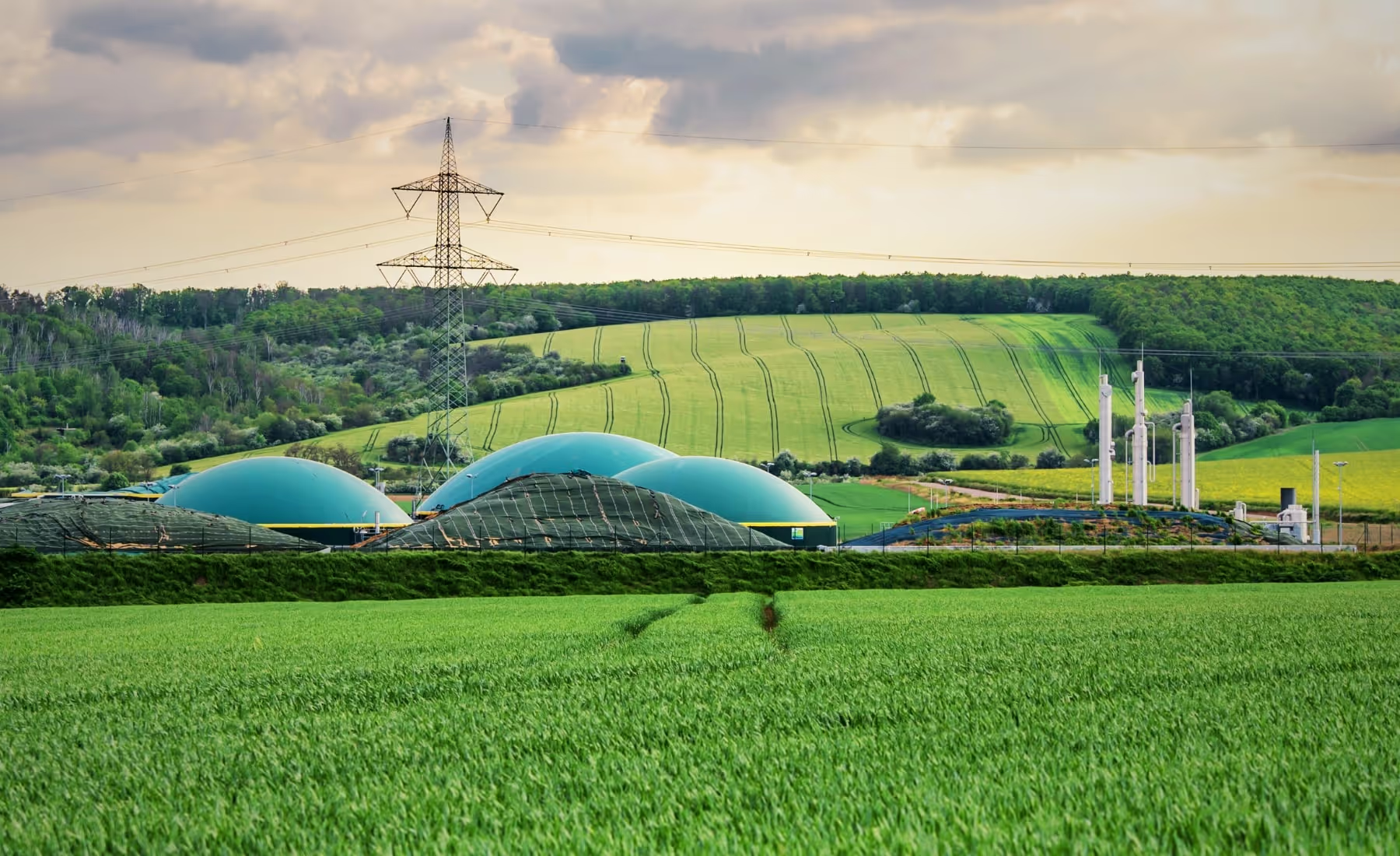
Our latest paper considers recent biomethane supply projections and assesses the likely feasibility of this ‘green gas’ replacing fossil fuels for consumer use.
With planning a critical enabler of net zero, our latest briefing explores the scale of the challenge and some of the practical solutions already being explored by local planning authorities.
With zonal pricing now ruled out, Johnny Gowdy considers the challenges and opportunities still facing the government to deliver investment and meaningful benefits for consumers before the next election.
Following the UK government's 'Energy Security Day', Estelle Limon, policy and impact coordinator at Regen, provides a snap summary of some of the most relevant announcements for the clean energy sector.
Merlin Hyman OBE
This year, the Welsh Government is aiming to develop a framework for a Just Transition. We welcome the opportunity to contribute their Call for Evidence. At Regen, we are placing a Just Transition at the forefront of our thinking.
Fraser Stewart
Sophie Whinney
Ellie Brundrett
In our latest insight paper, Johnny Gowdy discusses recent trends in CfD strike prices, the impact of this on future auctions and how rebuilding trust and collaboration between industry and government is essential to mitigate the growing delivery risk we are seeing.
Johnny Gowdy
In this insight paper, director Johnny Gowdy and project manager Ellie Brundrett explore the development of the current Capacity Market design, its evolution to date, and the role it should play in the energy system of the future.
Regen and the Electricity Storage Network have responded to the Inflexible Offer Licence Condition consultation from Ofgem.
Olly Frankland
On International Women's Day, Regen associate director Rachel Hayes explores the key challenges of increasing gender diversity in the energy sector.
Rachel Hayes
Regen's director Johnny Gowdy discusses the government's summary of REMA consultation responses.
Regen welcomes Climate Change Committee report on power decarbonisation as confirmation that decarbonising the UK's power sector by 2035 is achievable as well as necessary.
Regen and the Electricity Storage Network have responded to the government's consultation focusing on the future of the Capacity Market.
Regen has written the following response to the open consultation on reforms to national planning policy relating to onshore wind, led by the Department for Levelling Up, Housing and Communities (DLUHC).
Hazel Williams
On 20 February 2023, Regen's director Johnny Gowdy drafted an open letter to ministers and officials from the Treasury and the Department for Energy Security and Net Zero, raising concerns about UK investment attractiveness in light of the Electricity Generator Levy.
As the government consults on changes to future rounds of the Contracts for Difference (CfD) scheme, Regen's Estelle Limon and Johnny Gowdy explore whether factors beyond price should be taken into account when awarding CfD contracts to renewable developers.
Regen has worked with Wiltshire Council to set out how the area can deliver on its ambition of achieving carbon neutrality by 2030.
Meagan Reasoner
On Tuesday 24 January 2023, Regen's chief executive Merlin Hyman OBE gave evidence to the BEIS Select Committee on the subject of power decarbonisation and flexibility.
Regen's Energy Justice and Just Transition Lead Fraser Stewart discusses the vital importance of a 'just transition' to net zero.
Regen's chief executive, Merlin Hyman, responds to the publication of Chris Skidmore's independent Net Zero Review.
In Regen's first insight paper of 2023, director Johnny Gowdy analyses the emerging details of the government's new Electricity Generator Levy (EGL).
Christmas has come early for many after Ofgem announced its decision to implement a new 'Accelerated Strategic Transmission Investment' regulatory framework.
Grace Millman
Regen has written to BEIS Secretary of State on behalf of six UK energy trade bodies calling for urgent action to address constraints on the electricity network if the UK is to achieve net zero.
Read the final report from our study exploring how offshore renewable projects can provide benefits to local communities and areas, what local benefits look like in an offshore context, and why they are vital to a just transition and social acceptability for future projects in the UK.
Prina Sumaria
Poppy Maltby
The UK government's Net Zero Review aims to assess the economic co-benefits of delivering on net zero. In this insight piece, Regen's Policy and Impact Coordinator, Estelle Limon, highlights why this review is an important opportunity for the clean energy sector and how this opportunity can be unlocked in a way that benefits everyone.
Regen's 'Go West!' paper explores and identifies the benefits to the UK energy system and energy consumers of an offshore wind fleet that is more distributed around the UK.
Becky Fowell
Our new and improved final report with National Grid ESO analyses how the future net zero energy system will operate in challenging conditions on a difficult summer day and a difficult winter day in 2035.
Jonty Haynes
We have submitted our response to the BEIS Review of Electricity Market Arrangement consultation response. It's easily the longest consultation response Regen has written but, in truth, it could have been longer, there is so much to cover.
Simon Gill
The energy crisis poses a devastating challenge for many this winter. Though the recent announcement of the Government's Energy Price Guarantee has taken a small step in the right direction by setting the typical household's bills at £2,500, there are many groups still at severe, potentially life-threatening risk. One such group includes those with a disability who will likely pay more than the average £2,500.
Robbie Evans
As fossil fuel-dependent industries such as heavy transport look towards cheaper low-carbon options to help them decarbonise, Regen's energy analyst Jonathan Lamont assesses the potential future role of one option being considered, e-Fuels', and their viability to help the UK transition to net zero energy.
Ray Arrell
Regen responds to Ofgem's announcement of an increase to the energy price cap.
Regen has written to Ofgem's CEO raising concerns that the RIIO-ED2 price control risks preventing low-carbon technologies from connecting to the network at the speed and scale required to achieve net zero and provide a route away from our reliance on gas.
In this brand new insight paper, Regen identifies seven potential solutions to reduce the cost of balancing and managing constraints now.
Regen has written to the UK's new Electricity Networks Commissioner to draw attention to the urgency of addressing the constraints on the network if the UK is to achieve net zero and reduce our reliance on fossil fuels.
Regen has worked alongside the University of Exeter's Centre for Future Clean Mobility to produce a report outlining the technology innovation and economic growth opportunities that clean maritime propulsion systems can offer the UK and how the South West of England can capitalise on these opportunities and spearhead the growth of the sector.
The UK government is investing £160 million in port and manufacturing developments to bring us closer to deployment of 5 GW of floating offshore wind (FLOW) by 2030 and to unlock its role in the UK's wider net zero objectives. Regen has responded to the request for information to better understand how the Manufacturing Investment Scheme (FLOWMIS) can be designed to effectively use this funding.
Regen's CEO, Merlin Hyman, dissects current discussions on power market reform and the potential impacts for progress towards net zero.
Regen's Sophie Whinney explores the current gender gap within the heating sector and why diversity is essential in reaching all sections of society, on this divergence from business as usual.
When Emma Pavans de Ceccatty joined Regen, she brought with her an uncommon mix of disciplines — philosophy, environmental ethics, and art — and an instinct that the space between art and energy held untapped potential.
Chloe Uden
With the UK aiming to build and operate 50 GW of offshore wind by 2030, questions about who benefits from offshore developments, and how, have never been more pertinent. In this insight piece, we outline four key questions that need to be addressed to unlock benefit for local areas and communities, to support a truly just transition as we undertake the offshore revolution.
Low auction prices confirm that renewables are cheapest but we could have had a lot more. Now is the time to extend the use of Contracts for Difference to create a new deal between low carbon generators and the UK consumer.
This paper provides a framework for how national and local government can best work together to take the most cost-effective, place-based approach to addressing the decarbonisation of heat.
Regen welcomes the announcement of The Crown Estate's leasing strategy for the Celtic Sea, including the identification of five Areas of Search and an approach to phased development. This marks the start of the Celtic Sea leasing process and the unlocking of GWs of floating offshore wind on the West coast of the UK.
Regen's director, Johnny Gowdy, takes a look at Locational Marginal Pricing (LMP) in the US, focusing on Texas, to better understand the potential implications of an LMP-based market design for GB net zero investment.
Regen has published a report with Heart of the South West LEP and co-funded by Devon County Council, North Devon Council and Torridge District Council revealing how the economic opportunities from developing floating offshore wind in the Celtic Sea can be maximised.
Regen has been commissioned by ENA to revise and refresh the Energy Networks Innovation Strategy to ensure that network innovation continues to be coordinated, focused on the key priorities for the energy system and delivers benefits to energy consumers.
Christine Chapter
Tamar Bourne
Regen associate Simon Gill discusses how Scotland can begin to deliver upon its ambitious decarbonisation targets and unlock a demand-side revolution by taking a whole system approach, delivered in a coordinated way, with the support of everyone in Scotland, and to all our benefit.
Tamsyn Lonsdale-Smith
Joel Venn
In response to the shocking Russian invasion of Ukraine, we are expecting the Prime Minister to say more next week about the UK's energy strategy to free ourselves from Putin's "malign influence". Kwasi Kwarteng, among others, has debunked the idea we can drill our way to energy independence. Fantasies of fracking the UK countryside play into Putin's hands by distracting from real solutions. So here are seven things we think the Prime Minister should announce, building on the UK's ambitious Net Zero Strategy but with the much greater urgency the crisis has shown is required.
Energy price rises will impact millions of households in the UK, but what is the broader picture? George Middlemiss reflects on the unequal impacts of the latest price cap rise by Ofgem.
George Middlemiss
Regen has written to Ofgem setting out our concerns that the RIIO-ED2 process to date has left a significant risk that renewables and low-carbon technologies will not be able to connect to the network at the speed and scale required to achieve net zero.
Market-led systems alone are likely not to lead to empowered decision making in regards to home heating decarbonisation. Sophie Whinney explores the role of local governments and asks "how do we empower the public to get involved in heat decarbonisation?"





.jpg)
.jpg)
%20(1).jpg)
.jpg)