Johnny Gowdy examines plans to extend the Electricity Generator Levy and introduce a new Wholesale Contract for Difference for legacy generation assets, asking whether these measures are likely to reduce bills or provide meaningful protection for consumers in the near term.
Regen has partnered with DESNZ, Great British Energy and the Local Net Zero Hubs to create training and guides to support confident, consistent and timely decisions on applications for low-carbon energy generation, storage and network infrastructure.
In this first paper in a new insight series, we unpack what transmission constraints are, why they've increased and what's really driving the costs.
With more than half of GB’s current onshore wind fleet expected to face end-of-life decisions by 2035, repowering is a critical but overlooked consideration that will shape the UK’s future energy security. This paper highlights the barriers holding back onshore wind repowering and sets out urgent actions to unlock the potential of the existing fleet.
As part of the 2025 DFES update, we conducted an analysis of the growth and impact of data centres in National Grid Electricity Distribution’s licence areas. This paper summarises the potential future uptake of data centres, the geographical factors driving AI growth in particular areas, and commentary on the wider network and societal impacts of data centre development in the UK.
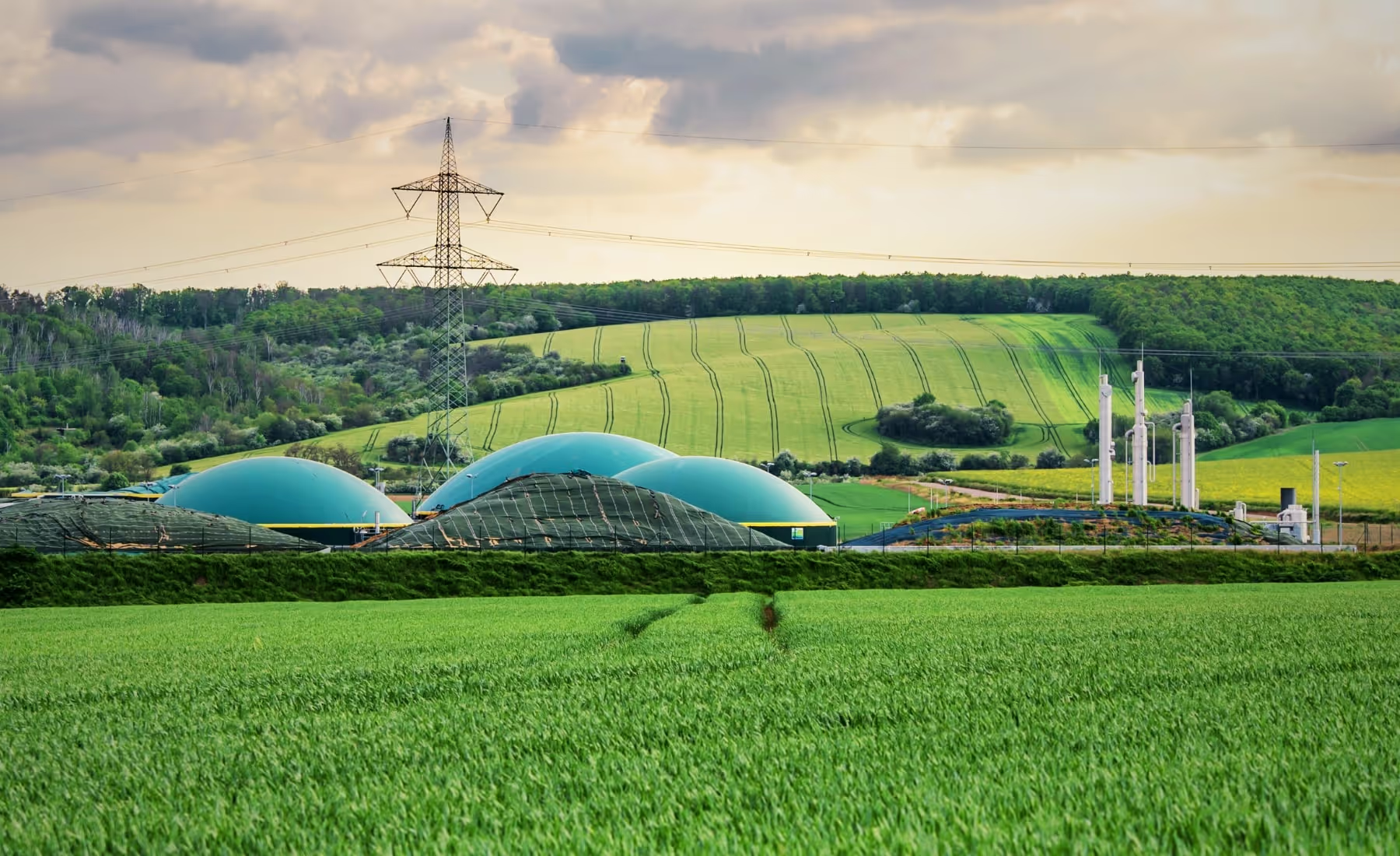
Our latest paper considers recent biomethane supply projections and assesses the likely feasibility of this ‘green gas’ replacing fossil fuels for consumer use.
With planning a critical enabler of net zero, our latest briefing explores the scale of the challenge and some of the practical solutions already being explored by local planning authorities.
With zonal pricing now ruled out, Johnny Gowdy considers the challenges and opportunities still facing the government to deliver investment and meaningful benefits for consumers before the next election.
TLDR: Almost certainly not, but reducing gas demand could.
Johnny Gowdy
In this insight, we look at what the Strategic Spatial Energy Plan will mean in practice and how it will shape planning decisions.
Anna Cuckow
Regen has worked with Innovate UK to create Local Energy Trackers for every local authority in the UK. The tool brings key datasets together in one place, helping councils, policymakers and communities better understand local progress and where action is needed.
Patti S
Poppy Maltby
Meagan Reasoner
This year’s winners reflect the breadth of innovation happening across the UK – from community-led energy models and local authority retrofit to whole-system thinking and pioneering individuals shaping the direction of the transition.
Anna Ali
In our response to the recent call for evidence on electricity market reform, we reiterated our support for Reformed National Pricing and emphasised the importance of delivering coordinated reforms that improve system operation, reduce constraint costs and accelerate investment in clean power.
Andrew Barry
Regen's consultation response welcomes EPC reform and many of the government’s proposals, while also calling for key changes.
Peter Griffin
Since 2016 Regen has worked with the Welsh government to track how energy is generated and used across Wales. This year’s edition brings generation and use together into one report for the first time, offering a clearer picture of the transition.
Shona R
Christine Chapter
Bruce Bardsley
Our response to the government’s consultation on reforms to the National Planning Policy Framework supports the direction of travel, but calls for the changes to go further.
Alex Temple
As oil and gas costs begin to climb once more, the government faces a familiar challenge – how to protect those most at risk while building an energy system that reduces exposure to future shocks. Grace Millman argues that the UK must move beyond blunt, crisis-era interventions and build a fairer energy system that properly supports households most exposed to energy price shocks.
Grace Millman
As part of Innovate UK's Net Zero Living Programme, Regen and the Carbon Trust piloted a new approach to identify, quantify and map community capacity to provide a more complete picture of vulnerability and resilience across three local authority areas.
Working with London Councils and Repowering London, Regen has created guidance to help time-constrained local authority officers enable community energy in their borough to flourish.
Alex Robertson
Prina Sumaria
Hazel Williams
Regen has responded to the UK government’s call for evidence on how the market for corporate power purchase agreements (CPPAs) in GB can be strengthened.
Becky Fowell
Ahead of International Women’s Day, Rachel Hayes reflects on running Regen’s women in renewables (ReWiRE) network – and on the impact of its mentoring programme, now in its 10th year.
Rachel Hayes
Developed with National Grid Electricity Distribution, this paper demystifies the planning process in England and Wales, offering a step-by-step guide to how projects are developed, assessed and approved.
Rebecca Windemer
Tamsyn Lonsdale-Smith
Our new guide for Innovate UK's Net Zero Living Programme sets out how to leverage local authority functions to drive a fair energy transition.
Fraser Stewart
Regen has responded to Ofgem’s consultation on the next steps of its end-to-end review of the electricity connections process.
Hannah Stanley
With delays in getting Gate 2 offers to developers, Merlin Hyman summarises where things currently stand for the connections reform programme – and what the key issues are that now need addressing.
Merlin Hyman OBE
Commissioned by Local Energy Scotland for the Scottish Government's Community and Renewable Energy Scheme, this practical, step-by-step resource is for community energy organisations and building owners looking to develop rooftop solar projects together.
Jessica Hogan
Robbie Evans
Marie Allen
The Strategic Spatial Energy Plan (SSEP) is currently in development to set new targets for electricity and hydrogen generation and storage projects in GB out to 2050. This insight piece sets out what these new targets could mean for grid connections and projects currently at Gate 1, as well as how developers can shape Regen’s engagement with the process.
Holly Hoban
As part of our work for Innovate UK’s Net Zero Living Programme, Regen explored what places across the UK have learned about strengthening local net zero planning, building investable project pipelines and mobilising finance.
Our latest paper with the William Grant Foundation explores what community capacity really means in practice – and what is needed to enable it more consistently, and more fairly, across different places.
Grace Millman unpacks the joint plan from Great British Energy and DESNZ, which commits to the biggest investment in community energy in British history.
Charlotte Wason
Our latest paper, produced for National Grid Electricity Distribution, examines the key trends, development pathways and innovations that will shape the future of community energy – and considers how DNO leadership can influence these.
With £15bn allocated to support homes and buildings to lower bills, reduce emissions and electrify, the delayed Warm Homes Plan is a major step towards decarbonising our buildings and growing the supply chain. Peter Griffin summarises the main takeaways.
Regen is partnering with art.earth Books to publish a new international collection on energy and imagination – and the call for submissions is now open.
Chloe Uden
Regen's response to the government consultation argues that moving costs into unit rates would fail to deliver a fairer charging model, risk worsening fuel poverty and undermine progress towards a just transition to clean heat.
This report brings together two decades of experimentation, collaboration and learning at the intersection of energy, creativity and public engagement.
The Electricity Storage Network (ESN) has responded to the government’s latest consultation on proposed changes to the Capacity Market.
Olly Frankland
Becca Ford considers how councils can build a transition that is fair, grounded in everyday realities, and shaped by the people it is designed to serve.
Rebecca Ford
Regen explored the varied approaches that local authorities are taking to embed climate action into their organisation, identifying three opportunities to clarify the roles and responsibilities of local authorities in relation to climate change.
Our analysis will feed into SSEN's network planning, optioneering and investment appraisal process and its ED3 business planning, as well as the transitional Regional Energy Strategic Plans.
Frank Hodgson
Ray Arrell
Jonty Haynes
Back in 2015, Regen delivered the first attempt at regional future energy scenarios, to support planning for the distribution network in NGED’s South West licence area. Here, Ray Arrell and Meagan Reasoner look at how our projections have stood the test of time.
In our latest paper for Innovate UK's Net Zero Living Programme, we examined the policies for renewable energy in all local plans across England, with startling results.
Regen has responded to Ofgem's consultation on its ED3 sector-specific methodology, welcoming the move towards longer-term, strategic planning for distribution networks.
Tamar Bourne
The UK government's target of 8 GW of locally and community-owned energy by 2030 is at risk if action is not taken to address the unique challenges these projects face in securing a grid connection. In partnership with Community Energy Scotland, we're calling for three changes to enable community energy projects in Scotland, where the problem is even more acute.
The Strategic Spatial Energy Plan could have a significant impact on which electricity generation, storage and grid projects get built, and where. This insight piece looks at the aims of the plan, the timeline and key developments.
Through the Net Zero Living Programme, UK places seeking a sustainable future have been looking to retrofit their building stock to create better, warmer homes to both improve lives and local economies.
The Electricity Storage Network has responded to two government consultations on the Capacity Market, looking at changes to 2026 prequalification and proposals on locational rules for Capacity Market units.
We have closely followed the development of the RESP since it was first announced by Ofgem in 2023, so it's exciting to see the details of NESO's approach bringing the vision a big leap closer to reality.
Our response to NESO's consultation welcomes the ambition behind the transitional Regional Energy Strategic Plan and makes a series of recommendations to ensure the final framework is pragmatic, evidence-based and delivery-focused.
For twenty years, glass artist Siddy Langley has been crafting the iconic Green Energy Awards trophies for Regen — elegant, hand-blown glass sculptures that shimmer with shades of green and light. Each one is unique, yet unmistakably part of a family — symbols of hope and ingenuity awarded to the people and organisations shaping the UK’s clean energy future.
The Electricity Storage Network has responded to Defra’s consultation on including battery storage in environmental permitting, drawing on extensive member input.
Regen submitted our views on the government’s consultation on reform to the Nationally Significant Infrastructure Projects (NSIP) service.
Peter Griffin argues that reducing VAT on gas and electricity is probably the easiest and quickest way for the chancellor to reduce household costs and show that the government is listening to the concerns of billpayers, but that there is an opportunity to go even further.
Regen welcomes government measures aimed at ‘unshackling Britain to get building’ will amend the Planning and Infrastructure Bill to cut delays, strengthen ministerial powers and accelerate infrastructure delivery.





.jpg)
.jpg)
%20(1).jpg)
.jpg)